The clinical use of prisms : and the decentering of lenses / by Ernest E. Maddox.
- Ernest Edmund Maddox
- Date:
- 1893
Licence: Public Domain Mark
Credit: The clinical use of prisms : and the decentering of lenses / by Ernest E. Maddox. Source: Wellcome Collection.
Provider: This material has been provided by UCL Library Services. The original may be consulted at UCL (University College London)
58/200 page 42
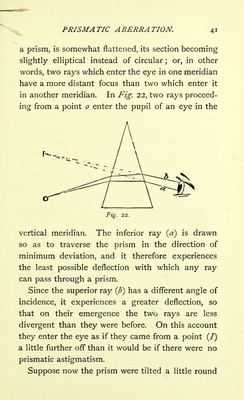
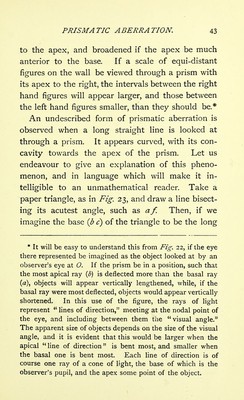
![its axis, so as to bring the superior ray, instead of the inferior, into the direction of minimum devia- tion. The conditions would then be reversed, for the inferior ray would be most deflected, and the two rays would enter the pupil more divergent, and as if they came from a point nearer t]\din they would do if there were no prismatic astigmatism. We see, therefore, that the nature of the astigmatism is altered according as the apex of the prism is moved (away from the position of minimum deviation) towards the object, or away from the object. The greater, too, the tilting, the greater the astigmatism.* One consequence of prismatic astigmatism is that objects appear altered in shape when viewed through a prism.' If square objects are looked at through a tilted prism, they appear oblong, being narrowed in one dimension, if the base of the prism be anterior * What about the rays which enter the horizontal meridian of the pupil ? Even they are not simple in their behaviour, but the more peripheral ones traverse the prism higher {i.e., nearer the edge) than the central ones, so that they describe an increasingly curved surface as they proceed from 0 till they reach the prism, and after leaving it, this transverse curve (with its concavity upwards) becomes less and less, till they enter the pupil in the straight line of its horizontal diameter. This will be easily understood after the explanation of the second form of prismatic aberration, since it depends on the fact that the peripheral rays have, after leaving the prism, a longer course than the central ones.](https://iiif.wellcomecollection.org/image/b2128586x_0058.jp2/full/800%2C/0/default.jpg)

 No text description is available for this image
 No text description is available for this image
 No text description is available for this image