Appendix to Third report of the Commissioners : minutes of evidence, April to July, 1907.
- Great Britain. Royal Commission on Vivisection (1906)
- Date:
- 1907
Licence: Public Domain Mark
Credit: Appendix to Third report of the Commissioners : minutes of evidence, April to July, 1907. Source: Wellcome Collection.
221/272 page 215
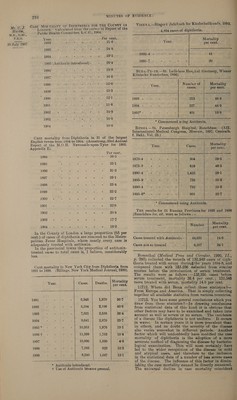
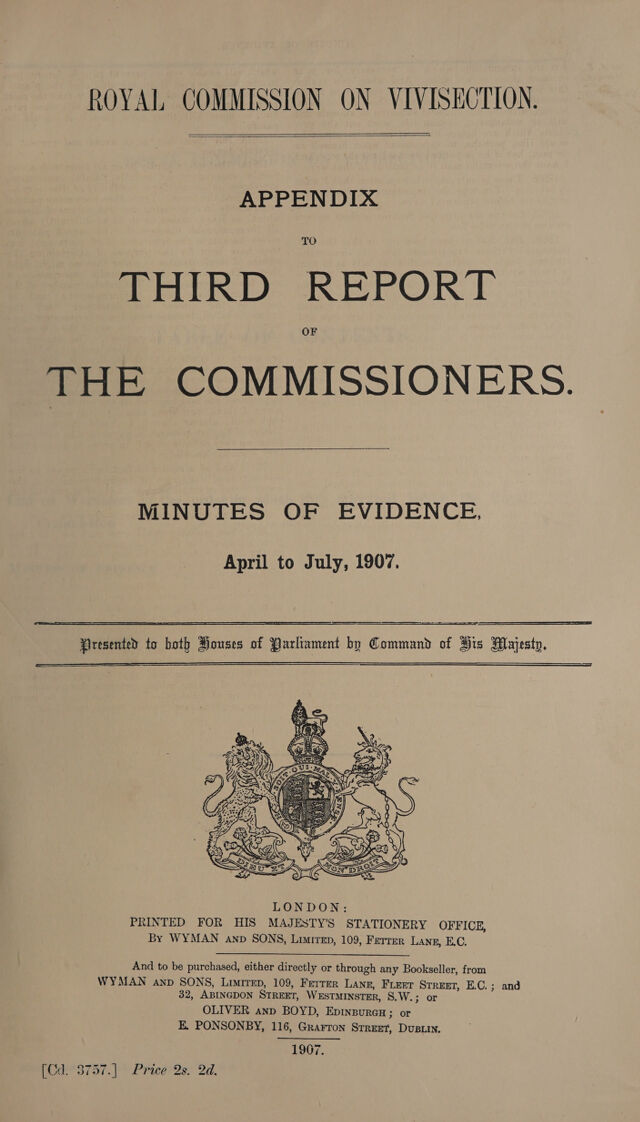
![¥ _ 11701. You have visited their place ?—Yes. 11702. (Sir Wulliam Church.) Would it not be safer 11703. (Chairman.) You mean in this country; you all over the world. : 11704. At any rate, we had better confine ourselves to this country, because that is all we have to inquir«. into. 11705. (Dr. Wilson.) May I ask, do you use mallein after the horse is bled, for the production of serum? You always use it before; but do you ever useit No. The mallein test is performed before the horse comes to us by the veterinary surgeon. 11706. What would be the effect of using it if used after the horse has been experimented on, aiter the toxin has been used for a horse that has been bled for some time /—I do not think there would be any effect. 11707. (Chairman.) At any rate, in your evidence you speak with confidence about your own institute ?— Certainly. 11708. And as to other institutes in this country, I understand it to be your belief, from personal observa- tion, that the process is carried out strictly there in the same way /—Certainly. ~ 11709. Will you describe the process of immunisa- tion ?—The animal is treated with increasing doses of the particular poison. The toxins are injected sub- cutaneously, intramuscularly, or intravenously, At first either very minute doses of weak toxins, or toxins which have been modified by chemical agents, or in others ways, are employed. tn the case of tetanus, in the early stages the toxin is usually modified by being treated with iodine. The first injection of the toxin may be followed by swelling at the site of inoculation, loss of appetite, general malaise, and rise of tempera- ture. When these have passed off the animal receives a second rather larger injection, and in this way the quantity of toxin is increased until, within a few months, the horse is capable of tolerating many thou- as a first injection. When the serum has reached the strength suitable for clinical use, blood is withdrawn from time to time by venesection. All the processes the strictest antisepsis. 11710. What precautions are employed in preparing the different sera ?—The vessels containing the sterile blood are removed into a small isolated building used for this purpose only. The serum, when it has sepa- rated from the clot, is decanted into sterilised vessels, the usual bacteriological precautions being taken to prevent the admission of extraneous germs. To the serum thus obtained 0.2 to 0.3 per cent. carbolic acid is added. As a final precaution the serum is passed through a Berkefeld filter. It is then in a condition to be put into the small phials in which it is sent out for use. Before this is done, however, it is sub- jected to the following tests:—l. For sterility. It must be germ-free. 2. For absence of toxicity. 3. For antitoxic value. This much reach a required standard. The last two tests are carried out on small animals. The serum is also kept for a certain time, during which the horse remains under observation ; if during this time the animal shows any signs of illness the serum is thrown away. It must be clearly understood that antitoxin is a substance which circulates in the blood of immunised animals, and which has been elabo- tated by the animal body. It has the property of rendering inert the particular poisons with which the animals were treated. It is a chemical substance which neutralises these poisons. Antitoxins are produced when a variety of poisons (all, however, of a complex nature) are introduced into an animal in suitable quantities. This property of stimulating the produc- tions of antitoxins by the animal body is not confined to the poisons produced by the organisms of disease. Snake poisons, most ferments, and several vegetable poisons also give rise to the production of anti-bodies, which neutralise the particular poison injected. Anti- toxins exert no influence upon the disease germs them- selves, but only upon their products ; the bacillus of diphtheria grows excellently well in diphtheria anti- toxin. Unfortunately, the useful application of anti- toxic serum-therapy is at present limited to a com- paratively few diseases. The most important of these are diphtheria, tetanus, and epidemic dysentery. The 215 value of serum-therapy in snake bite is limited, owing to the fact that the horse will not manufacture and Once a certain concentration of antitoxin is reached the animal ceases to react in this way to further injec- tions of venom. Moreover, a different antitoxin is re- quired for nearly every species of snake, which imposes practical difficulties in the way of this treatment. 11711. You have prepared, I think, various tables showing the curative value of diphtheria antitoxin ?— At the Medical Congress at Buda-Pesth in 1894 Roux communicated the results of the treatment with anti- toxin of 300 cases of diphtheria in the Paris Hospital. The mortality of those treated with antitoxin was 24 per cent., as against 60 per cent. in the non-treated. In another hospital in Paris, where antitoxin was not yet used the mortality was 80 per cent. The experi- mental and clinical data, and favourable statistics brought forward by Roux, led to the trial of this method of treatment for diphtheria in all civilised countries. Diphtheria antitoxin came into use in Eng- land in 1895, and immediately a fall in the case mortality in this disease was noticed in those insti- tutions where it was administered. I give some in- stances of the case mortality from diphtheria before and after the employment of the antitoxic treatment :— PARIS HospITAL (HERICOURT, 1899). Case mortality Mee per cent. 1893 - - - - : ke 45 1894* - : 2 : 3] 1895 : - : : : 12 > 2 es 4 = < 5:2 ee x Average 1897 - - = é 2 13:2 | 14 per cent. 1898 - e 4 3 y 14-5 * Commencement of the Antitoxic treatment. STATISTICS OF CASES OF DIPHTHERIA TREATED IN THE METROPOLITAN ASYLUMS BOARD HOSPITALS. (Annual Reports of M.A.B. Medical Supplement.) Coses wanted | foray Year. Per cent. of all Per ee ai all cases, rs = 1888-93 - - : — 28-5 1894 - - - a 29:6. 1895* - - : 61°8 22°5. 1896 - - Ales 20 8 1897 - : - 802 175, 1898 - - - 81°4 15:5: 1899 - : - — 13°95 1200 - - « - — 201 1901 - - > - —_ 125 1902. - - - — 11:0 1903. - - _— fh 1904 - - - - — 10°1 1905 - : - - -- 8°3 * Commencement of the Antitoxin period. Mr. 9. J Martin, FERS](https://iiif.wellcomecollection.org/image/b32182181_0221.jp2/full/800%2C/0/default.jpg)