[Report 1955] / Medical Officer of Health, Norfolk County Council.
- Norfolk (England). County Council.
- Date:
- 1955
Licence: Attribution 4.0 International (CC BY 4.0)
Credit: [Report 1955] / Medical Officer of Health, Norfolk County Council. Source: Wellcome Collection.
57/70 (page 49)
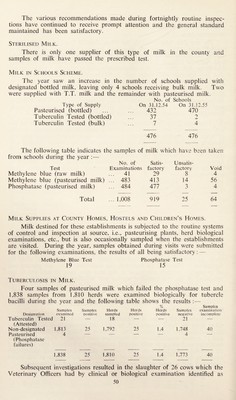
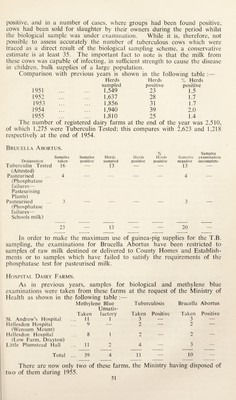
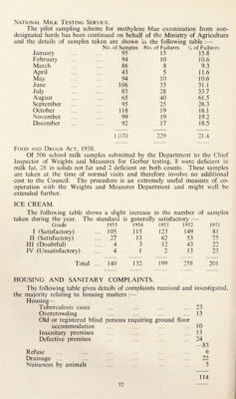
![MILK AND DAIRIES. Specified Area. On the 21st March, 1955, the Milk (Special Designation) (Specified Areas) Order, 1955, came into operation, bringing into force in the eastern part of the county the relevant Sections of the Food and Drugs (Milk, Dairies and Artificial Cream) Act, 1950. [This Act is now repealed by the Food and Drugs Act, 1955, which incorporates similar provisions]. These require that only specially designated milk, i.e. Tuberculin Tested milk (raw) and heat treated grades, shall be sold in areas specified by the Minister. The districts included in the Order are the Rural Districts of Depwade, Loddon, Blofield and Flegg, Smallburgh, St. Faith’s and Aylsham and Forehoe and Henstead and the Urban Districts of Diss, Wymondham and North Walsham together with the Norwich County Borough, Great Yarmouth County Borough, the Borough of Beccles and Bungay Urban District. Food and Drugs Authorities are responsible for the enforcement of the new requirements and in order to perform these duties adequately, records of some 180 retailers and producer/retailers have been prepared and the licensing position checked with the co-operation of the District Councils and the Ministry of Agriculture, Fisheries and Food (responsible respectively for registering and licensing of distributors and producer/retailers). When necessary, visits have been made to premises concerned and by the end of the year a scheme of sampling was in operation. Details of samples taken are given below :— Exami¬ Phosphatase Satis- Unsatis- Methylene Blue Satis- Unsatis- nations factory factory Void factory factory Void 51 21 28 1 (raw milk) 1 (overnight shade temperature exceeded 65 °F) In the course of enquiries, certain technical contraventions of the require¬ ments regarding bottling and labelling, etc., were discovered and the necessary advice given. In a few cases, it seemed that the particular circumstances might justify the Minister’s dispensation to allow the sale of small quantities of milk in isolated areas without conforming with the regulations. However, on approach, the dispensation was not granted and all producer/ retailers concerned in the area now have to conform to the provisions of the Act regarding sealing and labelling of containers. Pasteurising Plants. The number of pasteurising plants in operation at the end of the year (9) remained unchanged. Samples of all grades of pasteurised milk from each of the plants were taken from the retail rounds and, in all, 1,205 examinations (not including informal samples) were carried out. Of these, 5 failed the phosphatase test and 13 proved unsatisfactory on methylene blue testing. Four phosphatase tests were void owing to milk control exceeding 1.5 lovibond blue units, and 70 methylene blue tests were void owing to the overnight shade temperature exceeding 65 °F. Investigations of the failures were made at the plants concerned and in most cases the probable causes traced and rectified.](https://iiif.wellcomecollection.org/image/b29910882_0057.jp2/full/800%2C/0/default.jpg)