New developments in biotechnology : U.S. investment in biotechnology.
- United States Office of Technology Assessment
- Date:
- 1988
Licence: Public Domain Mark
Credit: New developments in biotechnology : U.S. investment in biotechnology. Source: Wellcome Collection.
294/308 (page 286)
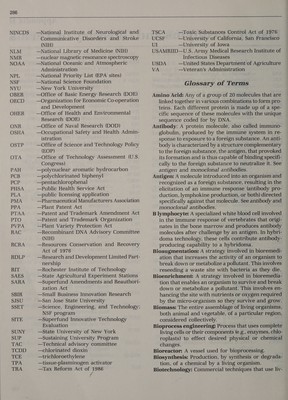
![NINCDS NLM NMR NOAA NPL NSF NYU OBER OECD OHER ONR OSHA OSTP OTA PAH PCB PCP PHSA PLA PMA PPA PTAA PTO PVPA RAC RCRA RDLP RIT SAES SARA SBIR SJSU SSET SITE SUNY SUP TAC TCDD TCE TPA TRA —National Institute of Neurological and Communicative Disorders and Stroke (NIH) —National Library of Medicine (NIH) —nuclear magnetic resonance spectroscopy —National Oceanic and Atmospheric Administration —National Priority List (EPA sites) —National Science Foundation —New York University —Office of Basic Energy Research (DOE) —Organization for Economic Co-operation and Development —Office of Health and Environmental Research (DOE) —Office of Naval Research (DOD) —Occupational Safety and Health Admin- istration —Office of Science and Technology Policy (EOP) —Office of Technology Assessment (U.S. Congress) —polynuclear aromatic hydrocarbon —polychlorinated biphenyl] —pentachlorophenal —Public Health Service Act —public licensing application —Pharmaceutical Manufacturers Association —Plant Patent Act —Patent and Trademark Amendment Act —Patent and Trademark Organization —Plant Variety Protection Act —Recombinant DNA Advisory Committee (NIH) —Resources Conservation and Recovery Act of 1976 —Research and Development Limited Part- nership —Rochester Institute of Technology —State Agricultural Experiment Stations —Superfund Amendments and Reauthori- zation Act —Small Business Innovation Research —San Jose State University —Science, Engineering, and Technology; NSF program —Superfund Innovative Technology Evaluation —State University of New York —Sustaining University Program —Technical advisory committee —chlorinated dioxin —trichloroethylene —tissue-plasminogen activator —Tax Reform Act of 1986 fi TSCA —Toxic Substances Control Act of 1976 UCSF —University of California, San Francisco UI —University of Iowa USAMRIID—U.S. Army Medical Research Institute of — Infectious Diseases USDA —United States Department of Agriculture VA —Veteran’s Administration Glossary of Terms Amino Acid: Any of a group of 20 molecules that are linked together in various combinations to form pro- teins. Each different protein is made up of a spe- cific sequence of these molecules with the unique sequence coded for by DNA. Antibody: A protein molecule, also called immuno- globulin, produced by the immune system in re- sponse to exposure to a foreign substance. An anti- body is characterized by a structure complementary to the foreign substance, the antigen, that provoked its formation and is thus capable of binding specifi- cally to the foreign substance to neutralize it. See antigen and monoclonal antibodies. Antigen: A molecule introduced into an organism and recognized as a foreign substance, resulting in the elicitation of an immune response (antibody pro- duction, lymphokine production, or both) directed specifically against that molecule. See antibody and monoclonal antibodies. B lymphocyte: A specialized white blood cell involved in the immune response of vertebrates that origi- nates in the bone marrow and produces antibody molecules after challenge by an antigen. In hybri- doma technology, these cells contribute antibody- producing capability to a hybridoma. Bioaugmentation: A strategy involved in bioremedi- ation that increases the activity of an organism to break down or metabolize a pollutant. This involves reseeding a waste site with bacteria as they die. Bioenrichment: A strategy involved in bioremedia- tion that enables an organism to survive and break down or metabolize a pollutant. This involves en- hancing the site with nutrients or oxygen required by the micro-organism so they survive and grow. Biomass: The entire assemblage of living organisms, both animal and vegetable, of a particular region, considered collectively. Bioprocess engineering: Process that uses complete living cells or their components (e.g., enzymes, chlo- roplasts) to effect desired physical or chemical changes. Bioreactor: A vessel used for bioprocessing. Biosynthesis: Production, by synthesis or degrada- tion, of a chemical by a living organism. Biotechnology: Commercial techniques that use liv-](https://iiif.wellcomecollection.org/image/b32222087_0294.jp2/full/800%2C/0/default.jpg)