An examination of some recent studies of the inheritance factor in insanity / by David Heron.
- Heron, David
- Date:
- 1914
Licence: In copyright
Credit: An examination of some recent studies of the inheritance factor in insanity / by David Heron. Source: Wellcome Collection.
Provider: This material has been provided by The Royal College of Surgeons of England. The original may be consulted at The Royal College of Surgeons of England.
27/32 page 379
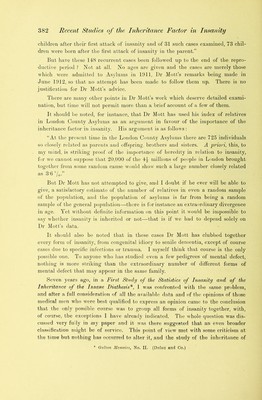
![at the age of 25 may safely marry. In an address delivered before the First International Eugenics Congress*, he said: “You will observe that 47'8 °/o of the 500 offspring had their first attack (of insanity) at or before the age of 25 years and as you see in the curves of parents and offspring, the liability of the child of an insane parent becoming insane tends rapidly to fall. Now besides the fact that this shows Nature’s method of eliminating unsound elements of a stock, it has another important bearing, for it shows that after twenty-five there is a greatly decreasing liability of the offspring of insane parents to become insane and therefore in the question of advising marriage of the offspring of an insane parent this is of great importance. Sir George Savage recently said that this statistical proof [sfc !] of mine entirely accorded with his own experiences, and that if an individual who had such an hereditary history had passed twenty-five and never previously shown any signs (of insanity) he would probably be free and he would offer no objection to marriage.” Now I entirely fail to understand how anyone could recommend marriage in such cases, even on Dr Mott’s own figures; for if it be true that 48 °/o become insane before 25, it must be equally true that 52 °/^ become insane after that age and this very important point seems to have been forgotten. These figures, however, are taken from Dr Mott’s selected data, selected in such a way that the early cases are enormously exaggerated. Until Dr Mott publishes a series of complete pedigrees, it will be safer to assume that the age at onset of insanity among the offspring of insane parents does not differ widely from that of all admissions to Asylums and there we find that only 21 °/^ become insane before 25, and 79 7o after 25. But surely at a Eugenics Congress of all places some thought might have been given to the mental condition of the children resulting from such matings, before advising marriage. It would not have been difficult for Dr Mott to have extracted all the available cases of this kind from his collection of pedigrees, i.e. all cases in which an individual had an insane parent and was normal at the age of 25, and so have discovered the probable fate of the offspring from such matings. Unfortunately the details given by Dr Mott regarding his pedigrees are usually so scanty that little use of them can be made, but two at least show the danger of the matings Sir George Savage and he sanction; these two pedigrees were given by Dr Mott in his lecture on Heredity in Relation to Insanity, delivered to the members of the London County Council. The first is shown in Fig. 14. (It appeared as Fig. 11, p. 18 of Dr Mott’s lecture.) In the first generation a man who became insane at 70 had four children. The eldest, a girl, became insane at 68 and was therefore normal long after the age of 25. Dr Mott does not state whether the marriage of this woman preceded or followed the onset of insanity in her father, but even if her father had become insane before her marriage. Dr Mott * Problems in Evgenies,]). 425. This is one of many illustrations of the evil done by that Congress; attention was directed and much weight given to hasty statements and ill-digested material.](https://iiif.wellcomecollection.org/image/b22463884_0029.jp2/full/800%2C/0/default.jpg)


 No text description is available for this image
 No text description is available for this image
 No text description is available for this image