Orthopædic surgery : a textbook of the pathology and treatment of deformities / by J. Jackson Clarke.
- Clarke, J. Jackson.
- Date:
- 1899
Licence: Public Domain Mark
Credit: Orthopædic surgery : a textbook of the pathology and treatment of deformities / by J. Jackson Clarke. Source: Wellcome Collection.
Provider: This material has been provided by UCL Library Services. The original may be consulted at UCL (University College London)
146/496 (page 122)
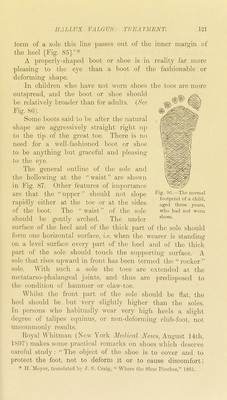
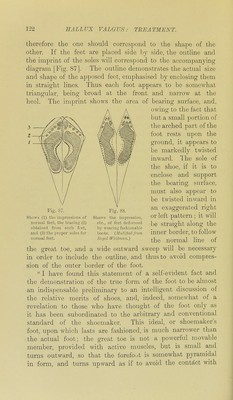
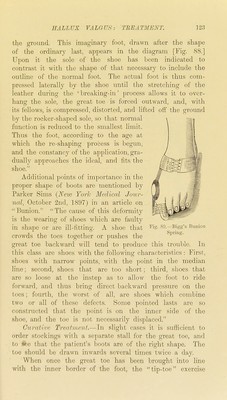
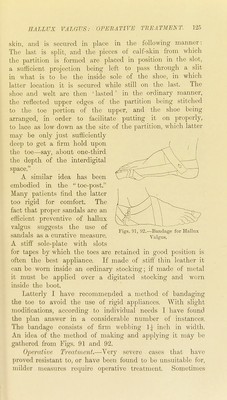
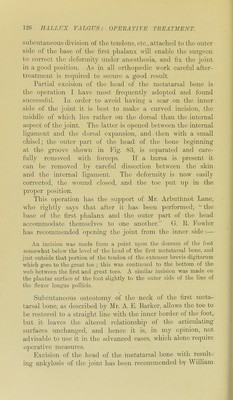
![therefore the one should corrGspond to the shape of the other. If the feet are placed side by side, the outline and the imprint of the soles will correspond to the accompanying diagram [Fig. 87]. The outline demonstrates the actual size and shape of the apposed feet, emphasised by enclosing them in straight lines. Thus each foot appears to be somewhat trianp-ular, beinof broad at the front and narrow at the heel. The imprint shows the area of bearing surface, and, owing to the fact that but a small portion of the arched part of the foot rests upon the ground, it appears to be markedly twisted inward. The sole of the shoe, if it is to enclose and support the bearing si irface, must also appear to be twisted inward in an exaggerated right or left pattern ; it will be straight along the inner border, to follow the normal line of the great toe, and a wide outward sweep will be necessary in order to include the outline, and thus to avoid compres- sion of the outer border of the foot. I have found this statement of a self-evident fact and the demonstration of the true form of the foot to be almost an indispensable preliminary to an intelligent discussion of the relative merits of shoes, and, indeed, somewhat of a revelation to those who have thought of the foot only as it has been subordinated to the arbitrary and conventional standard of the shoemaker. This ideal, or shoemaker's foot, upon which lasts are fashioned, is much narrower than the actual foot; the great toe is not a powerful movable member, provided with active muscles, but is small and turns outward, so that the forefo-t is somewhat pyramidal in form, and turns upward as if to avoid the contact with Fig. 87. Shows (1) the imijressions of nonual feet, the traciiif? (2) obtained fioiii such foet, and (3) the proper soles for normal feet. Fig. 88. Shows the impression, ete., of feet deformed by wearing fashionable boots. (Modified from Royal Whitman.)](https://iiif.wellcomecollection.org/image/b21290532_0146.jp2/full/800%2C/0/default.jpg)