Licence: Public Domain Mark
Credit: Thomson's Conspectus of the British pharmacopoeias. Source: Wellcome Collection.
32/248 page 4
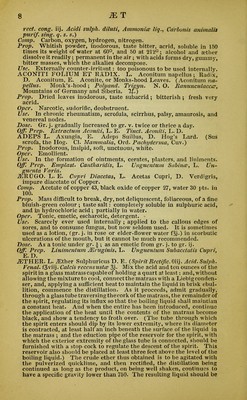
![Ojf. Prep. Tinctura Camphorce composite, L. Tinct. Opii Ammoniata, E. Tinct. Opii comphorata, E. D. ACIDUM CITRICUM. L. E. D. Citric Acid. Crystalli. Comp. Carbon 4 eq:==24*48+hydrogen 2=2+oxygen 4=32, eq. 58-48. Chemical Symbol, C or C4 H2. CH (Obtained from lemon juice.) Prop. Sharp acidity of lemon juice ; crystals right rhomboidal prisms, persistent, white, semi-transparent: soluble in less than twice their weight of cold water, and in half their weight of boiling water. In- cinerated with red oxide of mercury, no ash, or a mere trace is left. Oper. Refrigerant, antiseptic. Use. In febrile and inflammatory complaints, and scorbutus ; and dis- solved in water, instead of recent lemon juice, for the effervescing draught. (Proportion 3xjss. to water Oj.) Dose. Gr. x. to 3ss. dissolved in water, or any bland fluid. Incomp. Sulphuric acid, nitric acid, acetates of lead, nitrate and acetate of mercury, alkalies, alkaline sulphurets. Tests. Acetate of lead for detecting sulph. acid; potassa for tartaric acid ; when incinerated with red oxide of mercury, no ash is left. ACIDUM GaLLICUM. L. D. Gallic acid, crystals. Comp. Carbon 7 eq. =42-84 hydrogen 6 eq.=6+oxygen 5 eq.=40-f water ] eq.=±9=l 81*84- Chemical Symbol, C? H6 05 + H O. Ob- tained from gall-nuts.. Prop. Colourless, inodorous, with a slightly acidulous styptic taste, leaving a sweetish impression in the mouth ; sparingly soluble in cold water ; soluble in 3 parts of boiling water, and in alcohol. Oper. Astringent, styptic. Use. In hemorrhage, disquamative nephritis. Dose. Gr. iij. to v. in pill, or suspended in water by mucilage, 2 or 3 times a day. ACIDUM HYDROCHLORiCUM. L. Acidum Muriaticum. Aci- dum Muriaticum purum. E. D. Hydrochloric acid. Comp. Chlorine 1 eq. =35*42+1 hydrogen = l, eq. 36*42; real acid 1 atom; water 8 atoms. Chemical Symbol, H CI. {From common salt.) Prop. Odour suffocating, taste intensely acid and caustic ; nearly colourless when pure, but commonly of a pale yellow colour; volatile; the fumes visible; spec. grav. 1*160 to 1*100; spec. grav. of acid of commerce 1*180; 100 grains should saturate 132 grains of carbonate of soda. Oper. Tonic, antiseptic, diuretic. Use. In typhus ; cutaneous eruptions ; in gargles in inflammatory and putrid sore throats ; in injections in gonorrhoea. Dose. TljLx. to 111 xx. properly diluted; in gargles f3ss. to f3ij. in f$vi. of fluid ; injection HIviij. to water f^iv. Incomp. Alkalies, earths, and their carbonates, metallic oxides, sul- phuret of potassium, tartrate of potassa, tartar emetic, and most metallic salts. Tests. Chloride of barium in the diluted acid for sulph. acid ; L. am- monia for salts of iron. Off. Prep. Acidum Hydrochloricum dilutum, L. Acidum Muriaticum dilutum, E. D. Tinctura Ferri Sesquichloridi, L. E. D. Hydrochloras Barytce, E. Morphice Murias, E. D. Antimonii Potas&io-tartras, E. Ferri Ammoniochloridum, L. ACIDUM HYDROCHLORICUM DILUTUM. L. Aeidum Muri- aticum Dilutum, E. D. Diluted Hydrochloric Acid. (Acidi Hydro- chloride f3v.; Aquce distillate, f|xv.) f$i. should saturate gr. 168 of crystallized carbonate of soda. Sp. gr. 1*043. ACIDUM HYDROCYANICUM DILUTUM. L. D. ACIDUM HYDROCYANICUM. E. Diluted Hydrocyanic Acid. (Potassii Ferrocyanidi 3U; Acidi Sulph. f3vii.; Aq. Dist. Ojss.) 100 grains of the acid, treated with solution of nitrate of silver, should form gr.x. of cyanide of silver.](https://iiif.wellcomecollection.org/image/b20407142_0032.jp2/full/800%2C/0/default.jpg)

 No text description is available for this image
 No text description is available for this image
 No text description is available for this image