The relation between natural and synthetical glycerylphosphoric acids. Pt. 2 / by Frank Tutin and A.C.O. Hann.
- Tutin, Frank.
- Date:
- [1906]
Licence: In copyright
Credit: The relation between natural and synthetical glycerylphosphoric acids. Pt. 2 / by Frank Tutin and A.C.O. Hann. Source: Wellcome Collection.
10/14 page 1756
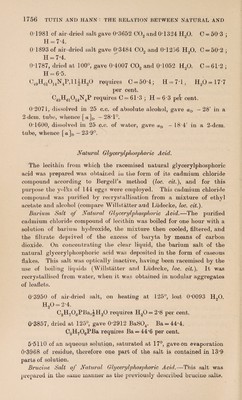
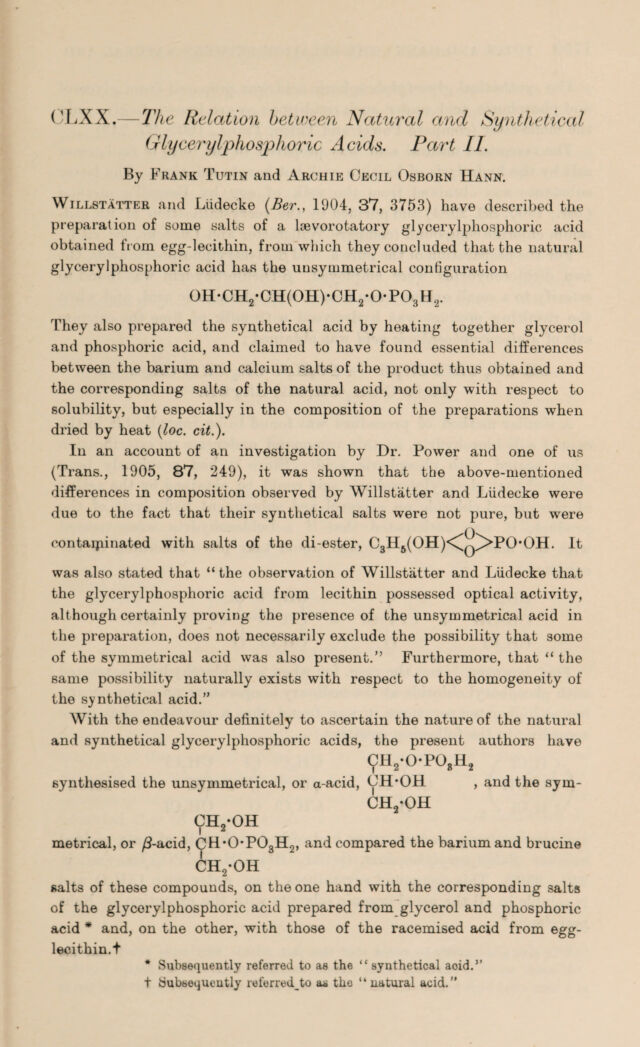
![01981 of air-dried salt gave 0*3652 C02 and 0*1324 H20. C = 50*3 ; H = 7*4. 0 1893 of air-dried salt gave 0*3484 C02 and 0*1236 H20. C = 50*2 ; H = 7*4. 0*1787, dried at 100°, gave 0*4007 C02 and 0*1052 H20. C = 61*2 ; H = 6*5. C49H61014N4P,11JH20 requires C = 50*4; 11=7*1, H20=17*7 per cent. C49H61014N4P requires C = 61*3 ; H = 6*3 peV cent. 0*2071, dissolved in 25 c.c. of absolute alcohol, gave aD -28' in a 2-dcm. tube, whence [a]D -28*1°. 0*1600, dissolved in 25 c.c. of water, gave aD - 18*4' in a 2-dcm. tube, whence [a]D — 23*9°. Natural Glycerylphosphoric Acid. The lecithin from which the racemised natural glycerylphosphoric acid was prepared was obtained in the form of its cadmium chloride compound according to Bergell’s method (loc. cit.), and for this purpose the yolks of 144 eggs were employed. This cadmium chloride compound was purified by recrystallisation from a mixture of ethyl acetate and alcohol (compare Willstatter aud Liidecke, loc. cit.). Barium Salt of Natural Glycerylphosphoric Acid.—The purified cadmium chloride compound of lecithin was boiled for one hour with a solution of barium hydroxide, the mixture then cooled, filtered, and the filtrate deprived of the excess of baryta by means of carbon dioxide. On concentrating the clear liquid, the barium salt of the natural glycerylphosphoric acid was deposited in the form of caseous flakes. This salt was optically inactive, having been racemised by the use of boiling liquids (Willstatter and Liidecke, loc. cit.). It was recrystallised from water, when it was obtained in nodular aggregates of leaflets. 0*3950 of air-dried salt, on heating at 125°, lost 0*0093 H20. H20 = 2*4. C3H706PBa,|H20 requires H20 = 2*8 per cent. 0*3857, dried at 125°, gave 0*2912 BaS04. Ba = 44*4. C3H706PBa requires Ba = 44*6 per cent. 5*5110 of an aqueous solution, saturated at 17°, gave on evaporation 0*3968 of residue, therefore one part of the salt is contained in 13*9 parts of solution. Brucine Salt of Natural Glycerylphosphoric Acid.—This salt was prepared in the same manner as the previously described brucine salts.](https://iiif.wellcomecollection.org/image/b30610035_0010.jp2/full/800%2C/0/default.jpg)