A review of Homoeopathy, allopathy, and "young physic" / by L.M. Lawson.
- Leonidas Merion Lawson
- Date:
- 1846
Licence: Public Domain Mark
Credit: A review of Homoeopathy, allopathy, and "young physic" / by L.M. Lawson. Source: Wellcome Collection.
Provider: This material has been provided by the National Library of Medicine (U.S.), through the Medical Heritage Library. The original may be consulted at the National Library of Medicine (U.S.)
12/38
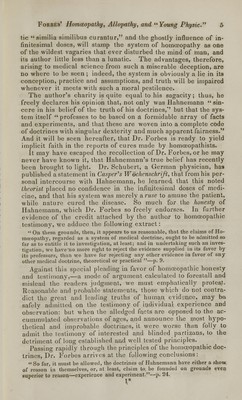
![agency in the cure of disease; upon what principle does the au- thor explain these discrepancies, and how docs he account for the success of an inert system of practice? The explanation is easily given. He believes that nature cures the disease avholly INDEPENDENT OF ANY MEDICAL AGENCY. _ _ _ Here the author's principles are fully developed; his opinions have been brought to a focus, and we can now explain the ground of his extraordinary admissions in favor of homoeopathy. It is important to remember, however, in immediate connection with the assumption that nature is the efficient agent in these homoeo- pathic cures, that Dr. Forbes has fully admitted, and distinctly declared, that the results of this system are quite as favorable as those belonging to allopathic practice; hence the unavoidable inference, that he regards the practice of medicine in no sense superior to the operation of natural causes! In Iruth, the fore- going being admitted, medical science sinks infinitely beneath the natural system or homoeopathy. This point, however, we can- not now pursue further, but leave it and follow the author in his somewhat tortuous course; and attempt by additional extracts to develope still more fully his views. After pursuing the subject for some time, and proving, as is supposed, the undoubted suc- cess of homoeopathic practice, the author makes the following issue: What, then, it will naturally be asked, is the explanation of the moment- ous fact we have announced, that a considerable number of diseases have been, and perhaps continue to be, treated as successfully by homocopathists as by allo- pathists? Is IT, THAT THE ONE KIND OF TREATMENT IS AS GOOD AS THE OTHER? Is IT, THAT HOMCEOr-ATHY IS TRUE? p. 78. To both of these interrogations, the author returns an une- quivocal and decided negative; and yet. in the next breath, the following escapes him: We may, indeed, have proof sufficient to satisfy any reasonable mind, that the theory or doctrines, or principles of homoeopathy are false; but as yet we have no demonstrative evidence that it is false in its practical bearings—false, that is, powerless, as a means of curing diseases. It will not be disputed by any one conversant with the history of medicine, that these two things are not only distinct, but independent of each other. We can, however, assert with the greatest pos.tiveness, that, as far as the evidence supplied by the documents now before us, or the evidence we have been able to gather from other pub- ished writings of the new school, goes,-there exists not a tittle of actual proof that homoeopathy is true in this aspect.—p. 79. Which, then, let us ask, is the better system? We are told by Dr. Forbes that homoeopathy cures as many cases as allo- pathy ; that homoeopathy cures none at all. and hence the corol- ary that allopathy is no better. And yet, in direct contradiction to his own admissions, and the common-sense of every physician we are sagely informed that there is no demonstrative evidence that it [homoeopathy] is false in its practical bearings;'' and >et, he adds, « there exists not a tittle of actual proof that homoeopathy ,8 true in this aspect. The emphasis on the](https://iiif.wellcomecollection.org/image/b21135940_0012.jp2/full/800%2C/0/default.jpg)