Report to the General Board of Health on a preliminary inquiry into the sewerage, drainage, and supply of water, and the sanitary condition of the inhabitants of the parish of Alverstoke, in the county of Southampton / by William Ranger, Superintending Inspector.
- William Ranger
- Date:
- 1852
Licence: Public Domain Mark
Credit: Report to the General Board of Health on a preliminary inquiry into the sewerage, drainage, and supply of water, and the sanitary condition of the inhabitants of the parish of Alverstoke, in the county of Southampton / by William Ranger, Superintending Inspector. Source: Wellcome Collection.
59/78 (page 57)
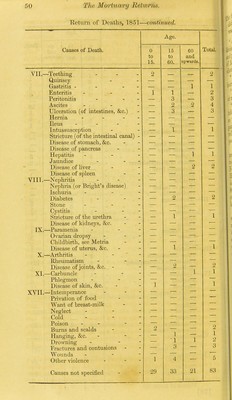
![The following written statement of the general history and con- dition of both the town of Gosport and the parish of Alverstoke was furnished to me by Mr. Neale. Alverstoke is an extensive and populous parish in the southern division of the county of Southampton, comprising the town and port of Gosport, the village of Alverstoke, and the chapelries of Anglesey, Forton, and Elson, The whole area of the parish is about 4,010 acres, 2,854 of these are under cultivation. The population in 1841 was 13,587; in 1851, 16,353 ; or an increase of 2,766 in ten years. In 1841 the total number of houses was2,598; in 1851, 3,028, or an increase of 430 houses in ten years. At the time of taking the last census, 99 houses were un- inhabited, but most of them were scarcely finished building, and so untenanted. There are not at present 50 houses in the whole parish unoccupied. The annual assessment of the parish to the relief of the poor is about 28,000^. The annual sum collected as poor rate is about 4,000/. There are no manufactories, the principal support of the neighbourhood are the Clarence Yard and Haslar Hospital for the royal navy. The head-quarters of the Royal Marines are at Forton barracks ; 1,000 men are generally stationed there. Haslar barracks are occupied by a company of Ai-tillery, or the depot of an Infanti'y regiment. The convict Hulks contain about 800 prisoners, and are supplied from the town. Many half-pay olBcers, pensioners, &c., I'eside in the locality. The number of houses in the town of Gosport is 1,553. The town of Gosport is surrounded by a strong line of field works, with a deep moat glacis, and covert way; the works from right to left mount 70 guns ; the Royal Clarence Victualling Yard is within the Avorks ; there are several pieces of meadow land also enclosed. There are three main streets, viz.. High-street (north and south), two open squares (Cold Harbour and the Green), and 13 other leading and open streets, containing about 780 houses fronting the road or street. There are about 104 courts or alleys, containing about 750 or 760 houses, locaUy known as small tene- ments. The population of the town is about 7,300. The total length of streets is less than 7,000 feet; the length of ordnance roads, within the town, about 2,400 feet. There are two main entrances into the town, one called the Double Gates, the other the Single Gate ; there is also another gate leading to Haslar Gate- way. Tlic streets of the town are lighted by gas lamps, there are 76 lamps ; the ordnance roads are not lighted. There are two churches, the one a district church, dedicated to the Holy Trinity; the burial-ground of the old church has been in use since 1689, it is barely an acre and a half; 150 corpses are on an average annually interred; this burial-ground is in a densely crowded locality. Trinity chui-ch was built or rebuilt under the powers of an Act of Parliament, obtained in the year 1825 by the Rev. R. Bingham, the present incumbent; it will hold about 2,000 persons. St. Mat- thew's, a parish for ecclesiastical purposes, stands to the north of the [78] D 2](https://iiif.wellcomecollection.org/image/b20423597_0065.jp2/full/800%2C/0/default.jpg)