Volume 2
Essays in historical chemistry / by T.E. Thorpe.
- Thomas Edward Thorpe
- Date:
- 1902
Licence: Public Domain Mark
Credit: Essays in historical chemistry / by T.E. Thorpe. Source: Wellcome Collection.
39/606 (page 23)
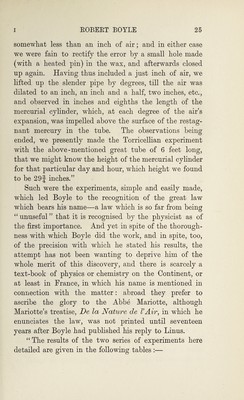
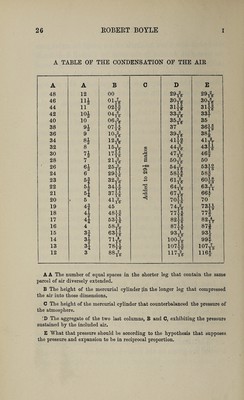
![one leg to the bottom of the divided paper, and just to the same height or horizontal line in the other, we took care, by frequently inclining the tube, so that the air might freely pass from one leg into the other by the sides of the mercury (we took, I say, care), that the air at last included in the shorter cylinder should be of the same laxity with the rest of the air about it. This done, we began to pour quicksilver into the longer leg of the syphon, which, by its weight pressing up that in the shorter leg, did by degrees straighten the included air; and continuing this pouring in of quicksilver till the air in the shorter leg was by condensation reduced to take up but half the space it possessed (I say possessed, not filled) before, we cast our eyes upon the longer leg of the glass, upon which we likewise pasted a list of paper carefully divided into inches and parts, and we observed, not without delight and satisfaction, that the quicksilver in that longer part of the tube was 29 inches higher than the other. Now that this observation does both very well agree with and confirm our hypothesis, will be easily discerned by him that takes notice what we teach : and Monsieur Pascal and our English friend’s [Mr. Townley’s] experiments prove, that the greater the weight is that leans upon the air, the more forcible is its endeavour of dilatation, and consequently its power of resistance (as other springs are stronger when bent by greater weights). For this being considered, it will appear to agree rarely well with the hypothesis, that as according to it the air in that degree of density, and correspondent measure of resistance, to which the weight of the incumbent atmosphere had brought it, was unable to counterbalance and resist the pressure of a mercurial cylinder of about 29 inches, as we are taught by the Torricellian experiment; so here the same air being](https://iiif.wellcomecollection.org/image/b31350975_0002_0039.jp2/full/800%2C/0/default.jpg)