How the wounded are cared for in war / by Sir George Thos. Beatson.
- George Beatson
- Date:
- [between 1910 and 1919?]
Licence: In copyright
Credit: How the wounded are cared for in war / by Sir George Thos. Beatson. Source: Wellcome Collection.
Provider: This material has been provided by The University of Glasgow Library. The original may be consulted at The University of Glasgow Library.
25/40 page 13
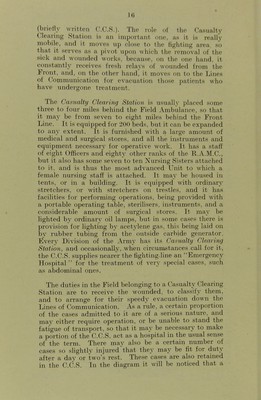
![Regimental Aid I^ost, Avhich is usually ])laced near a communication trench, and is uorked by the Regimental ^ledical Officer and by the Regimental Stretcher-Bearers. In connection with this stage of assistance, it shoidcl be noted that a Fir,st Field Dressing forms a component part of every British soldier’s kit on active sevice, so as to be available, at all times and in all places, as a first dressing for A^'Ounds. hen officers and men go on service, this First Field Dressing is carried in the pocket on the right side of the skirt of the frock. The next unit of assistance is the Advanced Dressing Station. It may be a mile or more behind the firing line, and it is placed in some sheltered position, var^fing with the locality. Thus, in the recent Somme Campaign, the Advanced Dressing Station at Vermeilles was in the cellar of a building, and the one at Contalmaison was in a captured roomy Army dug-out. It is worked by the Bearer Division of the Field Ambulance, and the dressing •of wounds is done at it. The next unit of assistance is the Field Ambulance, with its Dressing Station. It may be three miles or more from the firing line, and is generally located, if possible, in a building ; but recently, at the Somme, as all the buildings had been destroyed, it Avas housed in tents. This Field Ambulance is Avorked by the Tent Division of the Field Ambulance, and here dressings are readjusted and emergency operations done. To alloAv of the latter being carried out, the Field Ambulance possesses operating facilities, and has beds in the Tent Division. Briefly, it may be said that the chief Avork of these Units of Assistance in the Collecting Zone is to collect and bring into shelter the Avounded, so that they may receiA^e surgical first aid ; and, after this has been given, to mo\^e them backA\ards to the EA^ACUATING Zone. In the Evacuating Zone the transport is carried out at first by Btretcher-bearers, and aftenA ards b}^ the stretcher-bearers of the Bearer Division, or b}^ AAheeled stretchers. Sub- sequentl}, the transport from the Advanced Dressing Station to the Field Ambulances is done by Horse or Motor Ambulances. Coming noAv to the EVACUATING Zone, Avhich realU’^ has its field of A\'ork on the Lines of Communication, the first unit Ave come across is the Casualty Clearing Station](https://iiif.wellcomecollection.org/image/b24919044_0025.jp2/full/800%2C/0/default.jpg)