How the wounded are cared for in war / by Sir George Thos. Beatson.
- George Beatson
- Date:
- [between 1910 and 1919?]
Licence: In copyright
Credit: How the wounded are cared for in war / by Sir George Thos. Beatson. Source: Wellcome Collection.
Provider: This material has been provided by The University of Glasgow Library. The original may be consulted at The University of Glasgow Library.
28/40 page 16
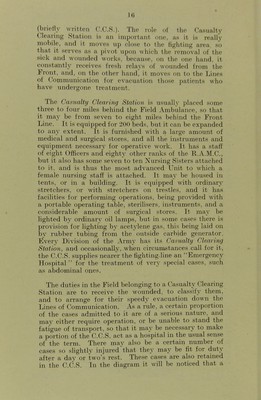
![10 (brielly written (\C.S.). The role of tlie (Jasualty Clearing Station is an iinj)ortant one, as it is really mobile, and it moves np close to the lighting area, so that it serves as a pivot ii])on which the removal of the sick and wounded Avorks, because, on the one hand, it constantly receives fresh relays of Avoiinded from the Front, and, on the other hand, it moves on to the Lines of Communication for evacuation those patients Avho have undergone treatment. The Casualty Clearing Station is usually placed some three to four miles behind the Field Ambulance, so that it may be from seven to eight miles behind the Front Line. It is equipped for 200 beds, but it can be expanded to any extent. It is furnished \\dth a large amount of medical and surgical stores, and all the instruments and equipment necessar}^ for operative work. It has a staff of eight Officers and eighty other ranks of the R.xl.M.C., but it also has some seven to ten Nursing Sisters attached to it, and is thus the most advanced Unit to Avhich a female nursing staff is attached. It ma} be housed in tents, or in a building. It is equipped Avith ordinary stretchers, or Avith stretchers on trestles, and it has facilities for performing operations, being pro Added Avith a portable operating table, sterilisers, instruments, and a considerable amount of surgical stores. It may be lighted b}^ ordinary oil lamps, but in some cases there is provision for lighting by acetylene gas. this being laid on by rubber tubing from the outside carbide generator. EA'erA’ Division of the Armj’ has its Casualty Clearing Station, and occasionally, when circumstances call for it, the C.C.S. supplies nearer the fighting.line an “Emergency Hospital ” for the treatment of A^eiy special cases, such as abdominal ones. The duties in the Field belonging to a Casualty Clearing Station are to receive the wounded, to classif}^ them, and to arrange for their speedy evacuation doAAn the Lines of Communication. As a rule, a certain proportion of the cases admitted to it are of a serious nature, and may either require operation, or be unable to stand the fatigue of transport, so that it maA be necessary to make a portion of the C.C.S. act as a hospital in the usual sense of the term. There may also be a certain number of cases so slightly injured that they may be fit for duty after a day or tAA^o’s rest. These cases are also retained in the C.C.S. In the diagram it Avill be noticed that a](https://iiif.wellcomecollection.org/image/b24919044_0028.jp2/full/800%2C/0/default.jpg)




 No text description is available for this image
 No text description is available for this image
 No text description is available for this image