Evolution and the Darwinian theory of human descent viewed from the standpoint of a multiple primate ancestry by Charles K. Mills : papers and discussion of the paper by Dr. Mills / Dr. Francis X. Dercum, Dr. William B. Cadwalader, Dr. J. Hendrie Lloyd and Dr. J. Parsons Schaeffer.
- Charles Karsner Mills
- Date:
- [1928]
Licence: In copyright
Credit: Evolution and the Darwinian theory of human descent viewed from the standpoint of a multiple primate ancestry by Charles K. Mills : papers and discussion of the paper by Dr. Mills / Dr. Francis X. Dercum, Dr. William B. Cadwalader, Dr. J. Hendrie Lloyd and Dr. J. Parsons Schaeffer. Source: Wellcome Collection.
17/28 (page 15)
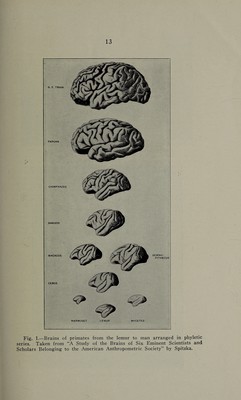
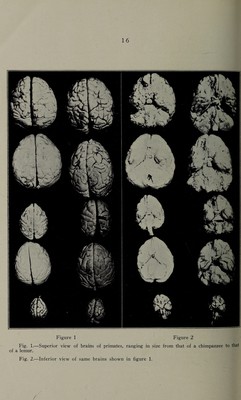
![Two pictures were shown of the brain of a confirmed murderer and criminal, Joseph Taylor. The brain showed many simian appearances and reversions. The next picture, taken from Spitzka, was a dorsal view of the brain of Gauss, the mathematician. This showed great fulness and complexity of the fissures and convolutions. The two illustrations show the lateral and mesial aspects of the brain of Joseph Leidy, from Spitzka’s book. Even a casual study of these pictures show how the brain of Leidy, like that of Gauss, differs in its surface morphology from the racial and low type brains just described. The third illustration gives a view of Darwin’s home “Downe House” (fig. 2) in Kent, England, and a photograph of Charles Darwin (fig. 3) taken from “The Life and Letters of Charles Darwin” by his son, Francis Darwin. Suggestions to Make the, Home of Darwin a National Shrine. In his presidential address at Leeds, Aug. 31, 1927, Sir Arthur Keith made an appeal for a fund to purchase Darwin’s home at Downe in Kent, so that it might be preserved for the nation. Mr. George B. Browne, a retired surgeon, on reading the appeal at once telegraphed to Sir Arthur, offering to make himself wholly responsible for the gift. The cost, with some endowment fund, is estimated at from $60,000 to $75,000. Mr. Browne made it a condition that no other contributor is to be asked to share the cost with him. Mr. Browne was admitted to the membership of the College of Surgeons in 1874, and for fourteen years acted as assistant to Sir Henry Thompson. He is an antiquarian and an enthusiastic collector. In offering to buy Downe House and to establish a fund for its perpetual upkeep, Mr. Browne is giving expression to his profound admiration for the work of the great naturalist. He considers that the house in which evolution was cradled should be as reverently preserved as Shakespeare’s birthplace. He desires that the house should be restored as nearly as possible to its condi¬ tion when Darwin lived there. When the house and garden have been restored, Mr. Browne wishes them to be opened without charge, to visitors who could then be shown Darwin’s study, laboratory and living-rooms much as when he left them. He also expressed the wish that some physician of slender means and good record should be appointed the custodian. Sir Arthur Keith has suggested that out of the endowment fund, money should be spared for a prize to be given every second year for the best con¬ tribution to biologic knowledge. Downe House is the property of Darwin’s son, Prof. Francis Darwin, and is now a school. Lantern Slide Demonstration of a Series of Primate Brains. Dr. William B. Cadwalader. Sir Arthur Keith, in a lecture given at Manchester, England, in August, 1927 {Brit. M. J. 2:441 [Sept. 10] 1927), quoted Prof. Elliot Smith, who sum¬ marized the results of his extensive anatomic studies as follows : “No structure found in the brain of an ape is lacking in the human brain, and, on the other hand, the human brain reveals no formation of any sort that is not present in the brain of the gorilla or chimpanzee. The only distinctive feature of the human brain is a quantitative one.” It is generally agreed that the brain of an anthropoid ape is surprisingly similar to that of man. In all apes each cerebral hemisphere (fig. 1) is divided into the same lobes as in man; that is to say, frontal, parietal, occipital and temporal. The cerebrum does not completely cover the cerebellum. The frontal and parietal lobes are separated by the central fissure. The arrangements of the motor centers is the same as that in man. This has been demonstrated experimentally by Sherrington and Griinbaum.](https://iiif.wellcomecollection.org/image/b3080131x_0017.jp2/full/800%2C/0/default.jpg)