(1) Notes on colloidon membranes for ultrfiltration and pressure dialysis / by G.S. Walpole. (2) Detection and concentration of antigens by ultrafiltration, pressure dialysis, etc., with special reference to diphtheria and tetanus toxins / by A.T. Glenny and G.S. Walpole.
- Walpole, George Stanley.
- Date:
- [1915?]
Licence: In copyright
Credit: (1) Notes on colloidon membranes for ultrfiltration and pressure dialysis / by G.S. Walpole. (2) Detection and concentration of antigens by ultrafiltration, pressure dialysis, etc., with special reference to diphtheria and tetanus toxins / by A.T. Glenny and G.S. Walpole. Source: Wellcome Collection.
10/30 page 290
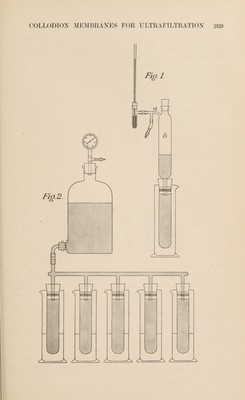
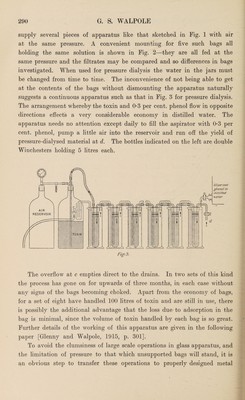
![supply several pieces of apparatus like that sketched in Fig. 1 with air at the same pressure. A convenient mounting for five such bags all holding the same solution is shown in Fig. 2—they are all fed at the same pressure and the filtrates may be compared and so differences in bags investigated. When used for pressure dialysis the water in the jars must be changed from time to time. The inconvenience of not being able to get at the contents of the bags without dismounting the apparatus naturally suggests a continuous apparatus such as that in Fig. 3 for pressure dialysis. The arrangement whereby the toxin and 0-3 per cent, phenol flow in opposite directions effects a very considerable economy in distilled water. The apparatus needs no attention except daily to fill the aspirator with 0*3 per cent, phenol, pump a little air into the reservoir and run off the yield of pressure-dialysed material at d. The bottles indicated on the left are double Winchesters holding 5 litres each. The overflow at c empties direct to the drains. In two sets of this kind the process has gone on for upwards of three months, in each case without any signs of the bags becoming choked. Apart from the economy of bags, for a set of eight have handled 100 litres of toxin and are still in use, there is possibly the additional advantage that the loss due to adsorption in the bag is minimal, since the volume of toxin handled by each bag is so great. Further details of the working of this apparatus are given in the following paper [Glenny and Walpole, 1915, p. 301]. To avoid the clumsiness of large scale operations in glass apparatus, and the limitation of pressure to that which unsupported bags will stand, it is an obvious step to transfer these operations to properly designed metal](https://iiif.wellcomecollection.org/image/b30621355_0010.jp2/full/800%2C/0/default.jpg)
 No text description is available for this image
 No text description is available for this image
 No text description is available for this image