(1) Notes on colloidon membranes for ultrfiltration and pressure dialysis / by G.S. Walpole. (2) Detection and concentration of antigens by ultrafiltration, pressure dialysis, etc., with special reference to diphtheria and tetanus toxins / by A.T. Glenny and G.S. Walpole.
- Walpole, George Stanley.
- Date:
- [1915?]
Licence: In copyright
Credit: (1) Notes on colloidon membranes for ultrfiltration and pressure dialysis / by G.S. Walpole. (2) Detection and concentration of antigens by ultrafiltration, pressure dialysis, etc., with special reference to diphtheria and tetanus toxins / by A.T. Glenny and G.S. Walpole. Source: Wellcome Collection.
18/30 page 298
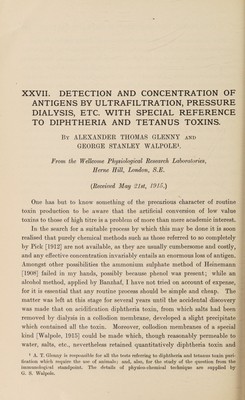
![XXVII. DETECTION AND CONCENTRATION OF ANTIGENS BY ULTRAFILTRATION, PRESSURE DIALYSIS, ETC. WITH SPECIAL REFERENCE TO DIPHTHERIA AND TETANUS TOXINS. By ALEXANDER THOMAS GLENNY and GEORGE STANLEY WALPOLE1. From the Wellcome Physiological Research Laboratories, Herne Hill, London, S.E. (Received May % 1st, 1915.) One has but to know something of the precarious character of routine toxin production to be aware that the artificial conversion of low value toxins to those of high titre is a problem of more than mere academic interest. In the search for a suitable process by which this may be done it is soon realised that purely chemical methods such as those referred to so completely by Pick [1912] are not available, as they are usually cumbersome and costly, and any effective concentration invariably entails an enormous loss of antigen. Amongst other possibilities the ammonium sulphate method of Heinemann [1908] failed in my hands, possibly because phenol was present; while an alcohol method, applied by Banzhaf, I have not tried on account of expense, for it is essential that any routine process should be simple and cheap. The matter was left at this stage for several years until the accidental discovery was made that on acidification diphtheria toxin, from which salts had been removed by dialysis in a collodion membrane, developed a slight precipitate which contained all the toxin. Moreover, collodion membranes of a special kind [Walpole, 1915] could be made which, though reasonably permeable to water, salts, etc., nevertheless retained quantitatively diphtheria toxin and 1 A. T. Glenny is responsible for all the tests referring to diphtheria and tetanus toxin puri¬ fication which require the use of animals; and, also, for the study of the question from the immunological standpoint. The details of physico-chemical technique are supplied by G. S. Walpole.](https://iiif.wellcomecollection.org/image/b30621355_0018.jp2/full/800%2C/0/default.jpg)

 No text description is available for this image
 No text description is available for this image
 No text description is available for this image