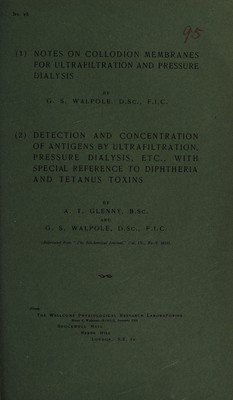
(1) Notes on colloidon membranes for ultrfiltration and pressure dialysis / by G.S. Walpole. (2) Detection and concentration of antigens by ultrafiltration, pressure dialysis, etc., with special reference to diphtheria and tetanus toxins / by A.T. Glenny and G.S. Walpole.
- Walpole, George Stanley.
- Date:
- [1915?]
Licence: In copyright
Credit: (1) Notes on colloidon membranes for ultrfiltration and pressure dialysis / by G.S. Walpole. (2) Detection and concentration of antigens by ultrafiltration, pressure dialysis, etc., with special reference to diphtheria and tetanus toxins / by A.T. Glenny and G.S. Walpole. Source: Wellcome Collection.
5/30 page 285
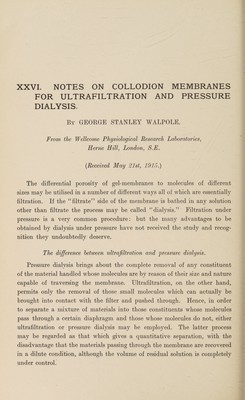
![Collodion membranes. The use of membranes of collodion for the pro¬ cesses referred to will always be associated with the names of Rodewald and Kattein [1900], Malfitano [1904], Duclaux [1905, 1907], Moore and Roaf [1907, 1908], Lillie [1907] and Bechold [1907, 1, 2, 3; 1908]. The last author used pressure and introduced the use of formalised gelatin as a filtering medium. To him, too, we are indebted for the word “ ultrafiltration,” which has now passed into general use. In this matter C. J. Martin [1896] anticipated many later developments by fully describing and illustrating special apparatus by which solutions to be investigated were forced under pressure through films of gelatin or silicic acid. The material impregnated was a Pasteur-Chamberland filter candle, which served as a support against disruption. In conjunction with T. Cherry [1898] such filtrations were used to demonstrate that diphtheria toxin-antitoxin mixtures after two hours’ standing at 30° gave toxin-free filtrates, although toxin when alone passed through the filters, and antitoxin, as shown by Brodie [1897] using Martin’s method, did not. My obj ect in this paper is to draw attention to the possibility of standard¬ ising accurately a series of filters, suitable for “ultrafiltration” and pressure dialysis operations, which are already in use. Also, to call attention to certain members of the series, that is to say those containing 5 mg. of nitro- cotton per sq. cm. and weighing 17*5 mg. per sq. cm. because of contained water. These have been discovered to be impermeable to all antigens tried, although they allow water, salts and simpler molecules to pass freely—a valuable conjunction of properties not shared, as far as I can discover, by the ultrafilters in general use. To make the matter clear, it may be stated as a result of direct com¬ parative experiments with parchment and from experience in the past with gelatin filters, that attempts to force diphtheria toxin under pressure of two atmospheres through parchment or gelatin would not result in nearly so much filtrate as if one of the “antigen-proof” collodion films to which I have referred were used. Further, as may be seen by referring to the original papers from the references given, they would not be found to keep back antigen to any great extent. The reason of this must, of course, in the present state of our knowledge of gel structure and the phenomena of filtration generally, be given with reservation. It would appear, however, not an unreasonable suggestion that these films possess an enhanced uniformity of structure and a great porosity. In other words, the channels leading from one side of the filter](https://iiif.wellcomecollection.org/image/b30621355_0005.jp2/full/800%2C/0/default.jpg)