Introduction to the study of organic chemistry : a text-book for students in the universitites and technical schools / by John Wade.
- Wade, John.
- Date:
- 1898
Licence: Public Domain Mark
Credit: Introduction to the study of organic chemistry : a text-book for students in the universitites and technical schools / by John Wade. Source: Wellcome Collection.
449/490 (page 427)
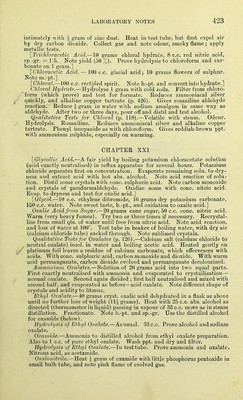
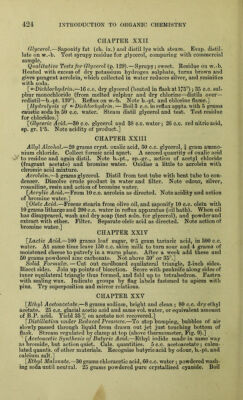
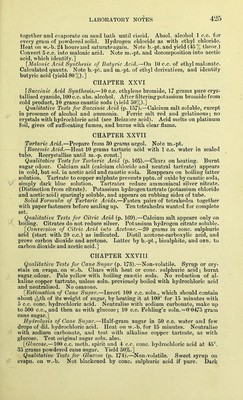
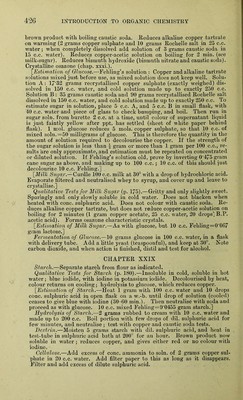
![Hydrolysis of Cellulose. Dissolve filter paper in 5 e c. couc. sulphuric acid, and heat. When cold, pour into 6 c.c. water, and boil vigorously. Neutralise and test with copper. Cellulose Nitrate.—As directed. Do not convert more thau 1 gram of cotton, and destroy product. CHAPTER XXX [Saccharic Acid.—20 grams cane sugar, 30 c.c. nitric acid, 15 c.c..water.] [Mannitol and Sorbitol.-—Invert 10 grams cane sugar. Reduce with sodium amalgam in acid solution, as with aldehyde. Note copper reducing power eventually vanishes. Evap. to dryness on w.-b., separating sodium sulphate, and extract with strong spirit.] [Hexyl Iodide.-—Distil 20 grams commercial manna from oil bath with 100 c.c. distilled hydriodic acid b.-pt. 125° and 5 grams red phosphorus, Pour back and redistil several times. Purify as with ethyl iodide. Note b.-pt. Reduce to hexane with zinc and dil. hydrochloric acid. Wash dry and note b.-pt. and sp.-gr., and compare with benzoline hexane.] CHAPTER XXXI Glucosazone.—2 grams glucose in 15 c.c. water, mixed with solution of 2 grams phenyl-hydraziue in just sufficient dil. acetic acid. Both filtered. Heat in small flask in beaker of boiling water. Wash dry. Take m.-pt. by capillary tube method. [.Synthesis of a-Acrose, etc.—Add 5 c.c. bromine (about) very slowly to 5 c.c. freshly distilled acrolein till just saturated. Keep ice-cold all the time. Mix product with ice-cold solution of 20 grams barium hydroxide in 100 c.c. water. Keep in cool place in loosely corked flask for a day or two. Then exactly ppt. barium with dilute sulphuric acid, and evaporate to syrup. Note hexose characters. Sweet. Reduces copper and silver, and forms a yellow osazone (mixture).] CHAPTER XXXII Urea from Urine.—100 c.c. fresh urine evaporated to one-sixth on w.-b. Cool syrup thoroughly aud add 16 c.c. of cone, nitric acid, keeping cool. Pour off mother liquor from nitrate, and drain on plate or loose asbestos plug in funnel. Wash with 5 c.c. cone, nitric acid. Barium carbonate as cream with water. Take m .-pt. Apply tests. Synthesis of Urea from Cyanide.—0 grams ordinary potassium cyanide thoroughly fused with 15 grams red lead in iron spoon or dish. Powder and boil with 30 c.c. water; filter; add 10 grams ammonium sulphate, and evaporate on w.-b. Extract hot wdtli metli. spit it. Take m.-pt. Apply tests. Hydrolysis of Urea.—1 gram boiled with very strong caustic soda solu.— 2 grams in 4 c.c. Prove ammonia and carbonate. Nitrous acid as with acetamide—1 gram. Prove nitrogen and carbon dioxide — one-third of evolved gas soluble in caustic soda. Hypobromite: Fill test tube with or- dinary caustic soda soln. to which bromine has been added—keepiug cold— until deep yellow colour. Invert in basin of caustic soda. Introduce | gram dry urea crystals, and compare volume of nitrogen with theoretical. Condensation of Urea.—Heat £ gram at 200° in dry test tube in sulphuric acid bath. Dissolve in dil. caustic soda and add very dilute oopper sulphate —violet biuret colour. Dissolve 1 gram urea in dil. hydrochloric acid, evap. to dryness on w.-b. Heat as directed, aiid convert half residue into barium salt—very little ammonia aud barium chloride. Heat other half strongly in dry test tube, and note pungent odour of cyanic acid. Qualitative Tests for Urea (p. 196). Non-volatile. Cryst. residue on evapn., especially from alcohol. Nitrate. Ammonia with concentrated soda only. Hypobromite. Cyanurate.](https://iiif.wellcomecollection.org/image/b28090676_0451.jp2/full/800%2C/0/default.jpg)