Introduction to the study of organic chemistry : a text-book for students in the universitites and technical schools / by John Wade.
- Wade, John.
- Date:
- 1898
Licence: Public Domain Mark
Credit: Introduction to the study of organic chemistry : a text-book for students in the universitites and technical schools / by John Wade. Source: Wellcome Collection.
460/490 (page 438)
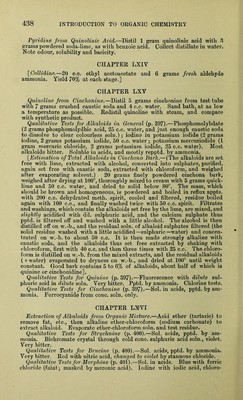
![Pyridine from Quinolinic Acid.—Distil 1 gram quinolinic acid with. 3 grams powdered soda-lime, as with benzoic acid. Collect distillate in water. Note odour, solubility and basicity. CHAPTER LX1V [Collidine.—20 c.c. ethyl aoetoacetate and 6 grams fresh aldehyde ammonia. Yield 70% at each stage.] CHAPTER LXV Quinoline from Cinchonine.—Distil 5 grams cinchonine from test tube with 7 grams crushed caustic soda and 4 c.c. water. Sand bath, at as low a temperature as possible. Redistil quinoline with steam, and compare with synthetic product. Qualitative Tests for Alkaloids in General (p. 397).—Pliosphomolybdate (2 grams phosphomolydbic acid, 25 c.c. water, and just enough caustic soda to dissolve to clear colourless soln.) ; iodine in potassium iodide (2 grams iodine, 2 grams potassium iodide, 50 c.c. water; potassium mercuriodide (l gram mercuric chloride, 2 grams potassium iodide, 25 c.c. water). Most alkaloids bitter. Soluble in acids, and mostly repptd. by ammonia. [Estimation of Total Alkaloids in Cinchona Bark.—(The alkaloids are set free with lime, extracted with alcohol, converted into sulphates, purified, again set free with caustic soda, extracted with chloroform, and weighed after evaporating solvent.) 20 grams finely powdered cinchona bark, weighed after drying at 100°, thoroughly mixed to cream with 5 grams quick- lime and 50 c.c. water, and dried to solid below 80°. The mass, which should be brown and homogeneous, is powdered and boiled in reflux appts. with 200 c.c. dehydrated meth. spirit, cooled and filtered, residue boiled again with 100 c.c., and finally washed twice with 50 c.c. spirit. Filtrates and washings, which contain the alkaloids set free by the lime, are mixed, and slightly acidified with dil. sulphuric acid, and the calcium sulphate thus pptd. is filtered off and washed with a little alcohol. The alcohol is then distilled off on w.-b., and the residual soln. of alkaloid sulphates filtered (the solid residue washed with a little acidified—sulphuric—water) and concen- trated on w.-b. to about 50 c.c. It is then made strougly alkaline with caustic soda, and the alkaloids thus set free extracted by shaking with chloroform, first with 40 c.c. and then three times with 25 c.c. The chloro- form is distilled on w.-b. from the mixed extracts, and the residual alkaloids ( +water) evaporated to dryness on w.-b., and dried at 100° until weight constant. Good bark contains 5 to 6% of alkaloids, about half of which is quinine or cinchonidine]. Qualitative Tests for Quinine (p. 397).—Fluorescence with dilute sul- phuric acid in dilute soln. Very bitter. Pptd. by ammonia. Chlorine tests. Qualitative Tests for Cinchonine (p.397).—Sol. in acids, pptd. by am- monia. Ferrocyanide from cone. soln. only. CHAPTER LXYI Extraction of Alkaloids from Organic Mixture.—Acid ether (tartaric) to remove fat, etc., then alkaline ether-chloroform (sodium carbonate) to extract alkaloid. Evaporate ether-chloroform soln. and test residue. Qualitative Tests for Strychnine (p. 400).—Sol. acids, pptd. by am- monia. Bichromate crystal through cold cone, sulphuric acid soln., violet. Very bitter. Qualitative Tests for Brucine (p. 400).—Sol. acids, pptd. by ammonia. Very bitter. Red with nitric acid, changed to violet by stannous chloride. Qualitative Tests for Morphine (p. 401).—Sol. in acids. Blue with ferric chloride (faint; masked by meconic acid). Iodine with iodic acid, chloro-](https://iiif.wellcomecollection.org/image/b28090676_0462.jp2/full/800%2C/0/default.jpg)