Licence: Public Domain Mark
Credit: Sales catalogue 519: Maggs Bros. Source: Wellcome Collection.
107/292 page 89
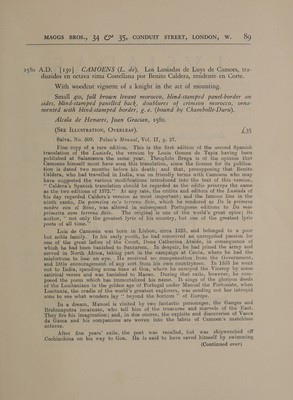
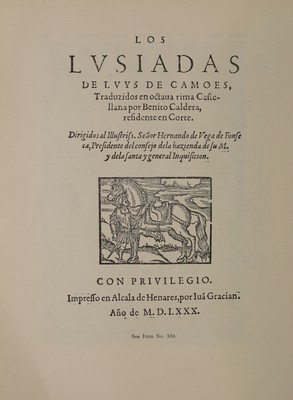
![1580 A.D. [130] CAMOENS (L. de). Los Lusiadas de Luys de Camoes, tra- duzidos en octava rima Costellana por Benito Caldera, residente en Corte. With woodcut vignette of a knight in the act of mounting. Small gto, full brown levant morocco, blind-stamped panel-border on sides, blind-stamped panelled back, doublures of crimson morocco, orna- mented with blind-stamped border, g.e. (bound by Chambolle-Duru). Alcala de Henares, Juan Gracian, 1580. (SEE ILLusTRATION, OvERLEAE). £35 Salva, No. 509. Palau’s Manual, Vol. IT, p. 27. Fine copy of a rare edition. This is the first edition of the second Spanish translation of the Lusiads, the version by Louis Gomez de Tapia having been published at Salamanca the same year. Theophilo Braga is of the opinion that Camoens himself must have seen this translation, since the licence for its publica- tion is dated two months before his death; and that, presupposing that Benito Caldera, who had travelled in India, was on friendly terms with Camoens who may have suggested the various modifications introduced into the text of this version, ‘‘ Caldera’s Spanish translation should be regarded as the editio princeps the same as the two editions of 1572.’’ At any rate, the critics and editors of the Lusiads of his day regarded Caldera’s version as most important; and the famous line in the ninth canto, Da primeira co'’o terreno Seio, which he rendered as De la primera madre con el Seno, was altered in subsequent Portuguese editions to Da mae primeira com terreno Seio. The original is one of the world’s great epics; its author, ‘‘ not only the greatest lyric of his country, but one of the greatest lyric poets of all time.’’ Luis de Camoens was born in Lisbon, circa 1525, and belonged to a poor but noble family. In his early youth, he had coneeived an unrequited passion ior one of the great ladies of the Court, Dona Catherina Ataide, in consequence of which he had been banished to Santarem. In despair, he had joined the army and served in North Africa, taking part in the campaign at Ceuta, where he had the misfortune to lose an eye. He received no compensation from the Government, and little encouragement of any sort from his own countrymen. In 1553 he went out to India, spending some time at Goa, where he annoyed the Viceroy by some satirical verses and was banished to Macao. During that exile, however, he com- posed the poem which has immortalized his name. It sings of the glorious deeds of the Lusitanians in the golden age of Portugal under Manuel the Fortunate, when Lusitania, the cradle of the world’s greatest explorers, was sending out her intrepid sons to see what wonders lay ‘‘ beyond the horizon ’’ of Kurope. In a dream, Manuel is visited by two fantastic personages, the Ganges and Brahmaputra incarnate, who tell him of the treasures and marvels of the Kast. They fire his imagination; and, in due course, the exploits and discoveries of Vasca da Gama and his companions are woven into the fabric of Camoen’s matchless octavas. After five years’ exile, the poet was recalled, but was shipwrecked off Cochinchina on his way to Goa. He is said to have saved himself by swimming. (Continued over)](https://iiif.wellcomecollection.org/image/b31664374_0107.jp2/full/800%2C/0/default.jpg)
 No text description is available for this image
 No text description is available for this image
 No text description is available for this image