Licence: Public Domain Mark
Credit: Sales catalogue 519: Maggs Bros. Source: Wellcome Collection.
24/292 page 16
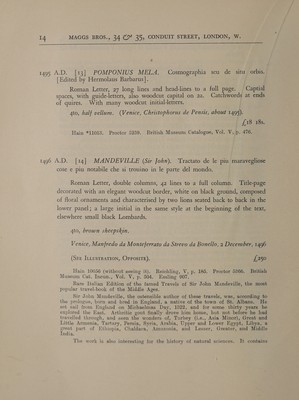
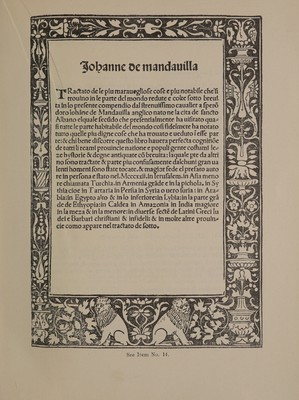
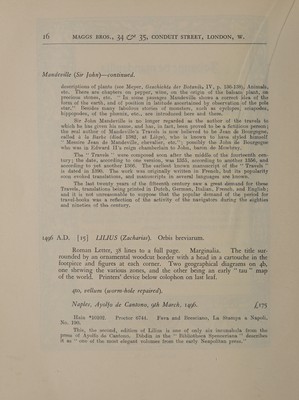
![- Mandeville (Sir John)—continued. descriptions of plants (see Meyer, Geschichte der Botanik, IV, p. 136-138), Animals, etc. ‘There are chapters on pepper, wine, on the origin of the balsam) plant, on precious stones, etc. ‘‘ In some passages Mandeville shows a correct idea of the form of the earth, and of position in latitude ascertained by observation of the pole star.’’ Besides many fabulous stories of monsters, such as cyclopes, sciapodes, hippopodes, of the phoenix, etc., are introduced here and there. Sir John Mandeville is no longer regarded as the author of the travels to which he has given his name, and has, in fact, been proved to be a fictitious person ; the real author of Mandeville’s Travels is now believed to be Jean de Bourgogne, called @ la Barbe (died 1382, at Li¢ge), who is known to have styled himself ‘‘ Messire Jean de Mandeville, chevalier, etc.’’; possibly the John de Bourgogne who was in Edward II’s reign chamberlain to John, baron de Mowbray, The ‘‘ Travels ’’ were composed soon after the middle of the fourteenth cen- tury; the date, according to one version, was 1855, according to another 1356, and according to yet another 1366. The earliest known manuscript of the ‘‘ Travels ”’ is dated in 13890. The work was originally written in French, but its popularity soon evoked translations, and manuscripts in several languages are known. The last twenty years of the fifteenth century saw a great demand for these Travels, translations being printed in Dutch, German, Italian, French, and English; and it is not unreasonable to suppose that the popular demand of the period for travel-books was a reflection of the activity of the navigators during the eighties and nineties of tha-century. 1496 A.D. [15] LILIUS (Zacharias). Orbis breviarum. Roman Letter, 38 lines to a full page. Marginalia. The title sur- rounded by an ornamental woodcut border with a head in a cartouche in the footpiece and figures at each corner. ‘Two geographical diagrams on 4b, one shewing the various zones, and the other being an early “tau” map of the world. Printers’ device below colophon on last leaf. 4to, vellum (worm-hole repaired). Naples, Ayolfo de Cantono, 9th March, 1496. L175 - Hain *10102. Proctor 6744.. Fava and Bresciano, La Stampa a Napoli, o. 190. This, the second, edition of Lilius is one of only six incunabula from the press of Ayolfo de Cantono. Dibdin in the ‘‘ Bibliotheca Spenceriana ’’ describes it as “‘ one of the most elegant volumes from the early Neapolitan press.”’](https://iiif.wellcomecollection.org/image/b31664374_0024.jp2/full/800%2C/0/default.jpg)
 No text description is available for this image
 No text description is available for this image
 No text description is available for this image