Licence: Public Domain Mark
Credit: Sales catalogue 519: Maggs Bros. Source: Wellcome Collection.
27/292 page 19
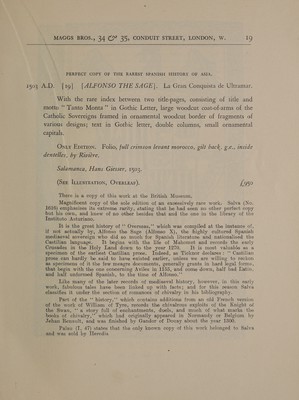
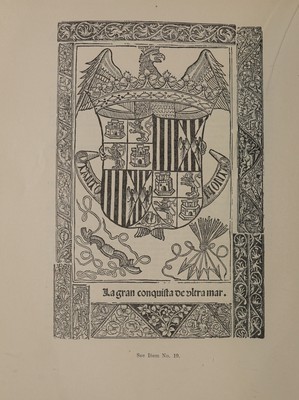
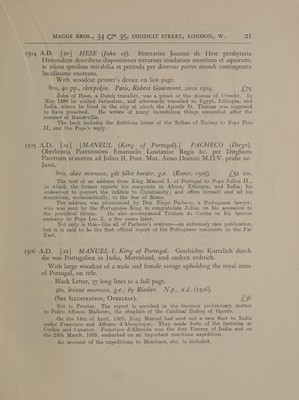
![PERFECT COPY OF THE RAREST SPANISH HISTORY OF ASIA. 1503 A.D. [19] [ALFONSO THE SAGE]. La Gran Conquista de Ultramar. With the rare index between two title-pages, consisting of title and motto “Tanto Monta” in Gothic Letter, large woodcut coat-of-arms of the Catholic Sovereigns framed in ornamental woodcut border of fragments of various designs; text in Gothic letter, double columns, small ornamental capitals. Onty Epirion. Folio, full crimson levant morocco, gilt back, g.e., inside dentelles, by Riviere. Salamanca, Hans Giesser, 1503. (See Intusrration, Overvear). £950 There is a copy of this work at the British Museum. Magnificent copy of the sole edition of an excessively rare work. Salva (No. 1616) emphasises its extreme rarity, stating that he had seen no other perfect copy but his own, and knew of no other besides that and the one in the library of the Instituto Asturiano. It is the great history of ‘‘ Overseas,’’ which was compiled at the instance of, ° if not actually by, Alfonso the Sage (Alfonso X), the highly cultured Spanish mediaeval sovereign who did so much for Spanish literature and nationalised the Castilian language. It begins with the life of Mahomet and records the early Crusades in the Holy Land down to the year 1270. It is most valuable as a specimen of the earliest Castilian prose. Indeed, as Ticknor declares: ‘‘ Castilian prose can hardly be said to have existed earlier, unless we are willing to reckon as specimens of it the few meagre documents, generally grants in hard legal forms, that begin with the one concerning Aviles in 1155, and come down, half bad Latin, and half unformed Spanish, to the time of Alfonso.”’ Like many of the later records of mediaeval history, however, in this early work, fabulous tales have been linked up with facts; and for this reason Salva classifies it under the section of romances of chivalry in his bibliography. Part of the ‘‘ history,’’ which contains additions from an old French version of the work of William of Tyre, records the chivalrous exploits of the Knight of the Swan, ‘‘ a story full of enchantments, duels, and much of what marks the books of chivalry,’’ which had originally appeared in Normandy or Belgium by Jehan Renault, and was finished by Gandor of Douay about the year 1300. Palau (I, 47) states that the only known copy of this work belonged to Salva and was sold by Heredia](https://iiif.wellcomecollection.org/image/b31664374_0027.jp2/full/800%2C/0/default.jpg)
 No text description is available for this image
 No text description is available for this image
 No text description is available for this image