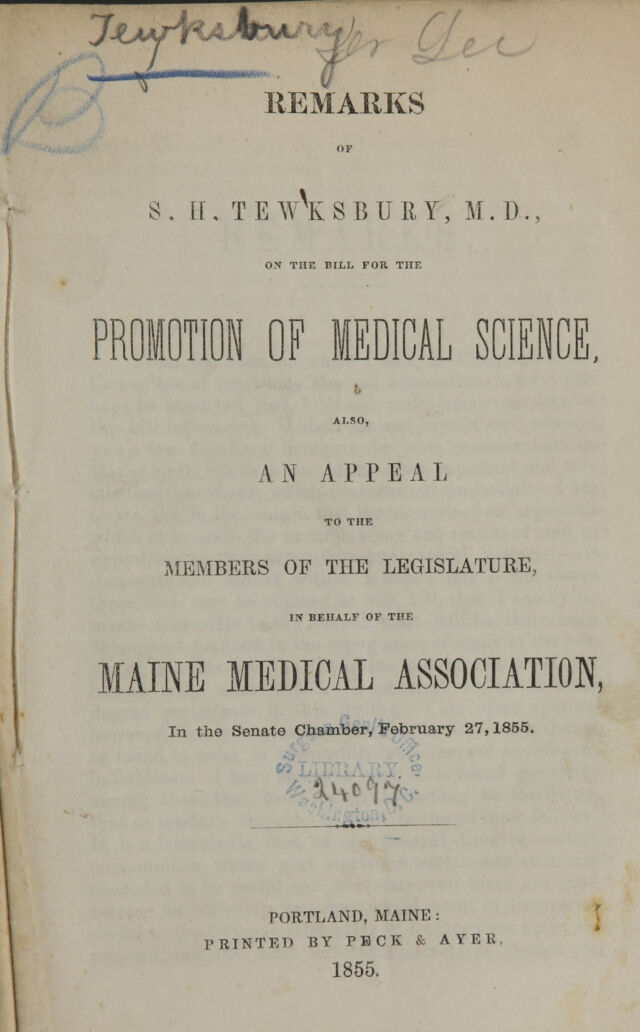
Remarks of S.H. Tewksbury, M.D. on the bill for the promotion of medical science : also, an appeal to the members of the legislature in behalf of the Maine Medical Association, in the Senate chamber, Feb. 27, 1855.
- Tewksbury, S. H. (Samuel Henry), 1819-1880
- Date:
- 1855
Licence: Public Domain Mark
Credit: Remarks of S.H. Tewksbury, M.D. on the bill for the promotion of medical science : also, an appeal to the members of the legislature in behalf of the Maine Medical Association, in the Senate chamber, Feb. 27, 1855. Source: Wellcome Collection.
Provider: This material has been provided by the National Library of Medicine (U.S.), through the Medical Heritage Library. The original may be consulted at the National Library of Medicine (U.S.)
17/28
![V most uncultivated and the most : G i sd. There is a general feeling and conviction of its necessity, however, anion a goodly portion for the jmont of science, and the opposition that is now made, is not so much against anatomy, as against the practice of exhumation, — an ' I a prac- tice that ought to be opposed. r ho said that sub- jects for dissection can now be obtained. True, they can ; but not by permission of law. The necessities and require- ts drive us to violate the law, and thereby for every one thus obtaii > distinct crimes are committed. ling, which is felony, — and robbing the grave, which is another felony. Wo do not blame the people for making this practice felony, but wo do blame them for stopping here. We maintain that it is absurd, wicked and criminal to make exhumation felony, without providing some other method, for the cultivation of anatomy. The robbing of the grave is the only method by which subjects for dissec- tion can be obtained. They cannot be procured in New York or Massachusetts, as it is generally supposed that the physicians in this State arc supplied from tins source, for the laws of these States prevent it. [See the last clause in the second section of the New York law: ': Whoever shall remove such remains beyond the limits of the State, shall on conviction be adjudged guilty of a criminal offence, and shall be imprisoned in one of the State's Prisons of this State, for a term not less than one year.] It is due therefore to the people of this State, for the protection of their kindred dead, as well as to the profes- sion of medicine, to provide facilities for the acquisition of that knowledge that will be afforded by this bill, unless some other equally efficacious means can be devised, which I presume will not bo pretended by the opponents of this measure, for subjects for dissection must be procured, and be the difficulties what they may, ivitthQ procured. Diseases will occur,— operations must bo performed,— medical men must be educated, — anatomy must be studied,—dissec- tions must go on, — and unless some legal means be adopted for affording a supply, whatever be the ^fe or popular 3 j£*d](https://iiif.wellcomecollection.org/image/b21158435_0017.jp2/full/800%2C/0/default.jpg)


 No text description is available for this image
 No text description is available for this image
 No text description is available for this image