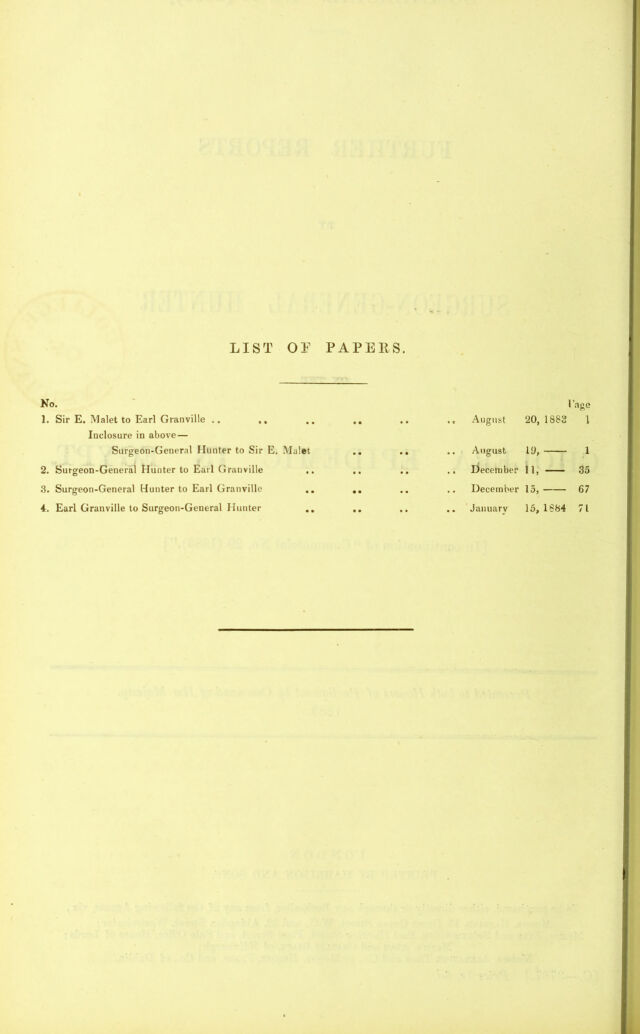
Further reports by Surgeon-General Hunter on the cholera epidemic in Egypt.
- Hunter, William Guyer.
- Date:
- 1883
Licence: Public Domain Mark
Credit: Further reports by Surgeon-General Hunter on the cholera epidemic in Egypt. Source: Wellcome Collection.
Provider: This material has been provided by Royal College of Physicians, London. The original may be consulted at Royal College of Physicians, London.
23/80 page 21
![que comme il regnait deja a Damiette le cholera nostras sporadic]ne comme le mentionna M. le Dr. Mood, c’est le meme cliolera nostras qni, se developpant sur une pins vaste echelle a change de forme, et a pris la forme epidemique probablement en consequence des mauvaises conditions hygieniqucs existantes a Damiette. Yeuillez, &c. Le Directeur, (Signe) Dn. Freda, Son Excellence Hassan Pacha Mahmoud, President du Conseii Sanitaire Maritime et Quarantenaire, Alexandrie, (Translation.) The Outbreak of Cholera at Damietta in 1883. Its Origin ancl Spread,” Report to the Maritime Sanitary and, Quarantine Board of Egypt, by Ahmed Chaffey Bey and Salvatore Ferrari. Damietta, July 24, 1883. THE two Committees, of which the Undersigned were members, and which came to Damietta the 14th June, 1883, to ascertain the existence and nature of the disease which was raging in that town, having pronounced it epidemic cholera, the Maritime Sanitary and Quarantine Board instructed me at its meeting of the 27th June to go to Damietta to inquire into the origin of the cholera epidemic. Dr. Ferrari, Director of the Health Office at Damietta, was ashed to join me in fulfilling the mission confided to me by the Board. Ptelying on the confidence thus placed in us, and thoroughly appreciating; the importance of the matter, we made long and minute inquiries, the result of which will be found in the Report which we now have the honour to submit to the Council. § I.—Topographical and Hydrographical Sketch of the Toiun of Damietta, from a Medical Point of View. The town of Damietta is on the east bank of the Nile, about 13 miles above where it runs into the Mediterranean. The soil on which the town, which is actually washed by the waters of the river, stands is Nile alluvium. The construction and lie of the town is in shape like a liorse-shoe, in the curve of which the current is considerably delayed, and at the period of the lowr wrater of the Nile the sea runs back into it. The towm consists of very ancient buildings, saturated with damp, very crowhed, for the most part in ruins, without any yards, and those which look as if they had yards have only a sort of narrow hall, which is both clamp and dark. This is the case with the dwellings of the moderately well-to-do, while the greater number of the houses are in reality nothing more than mere underground cellars, wdiich could well be called cesspools. Besides these there is a third kind of dwelling very common throughout the country, namely, the huts or cabins made of straw-, mud, and animal excrement. The streets are very narrow and crooked, the sun hardly ever shines into them. There is no boulevard, public place, or garden. The surface covered by the town may be about 1 kilom. long by nearly 600 metres wide. According to the returns of the last census the population of Damietta is 35,000. The population is of the Egyptian face, almost unmixed ; the Syrian element is represented by hardly a thousand individuals; there are but very few Europeans. There are a few merchants and rice growers, but the principal occupations are those of the sailor and fisherman. Mohammedanism is the dominant religion. The whole population, including even the rich natives, feed almost exclusively on fish and rice. A large proportion of the natives prefer a kind of rotten salt fish called “ fissikh ” (herrings). The only drink is wrater. The rich fill their cisterns with the water of the high Nile, and thus lay in a supply for seven months; but those who have no cisterns drink throughout the year water which they draw from the river, or from the haligh (canal) which runs through the eastern part of the town. There are empty barracks, a factory in ruins, and one single hospital with ona doctor and one chemist; there is no school,](https://iiif.wellcomecollection.org/image/b24975370_0025.jp2/full/800%2C/0/default.jpg)