Licence: In copyright
Credit: A manual of physiology : with practical exercises / by G.N. Stewart. Source: Wellcome Collection.
Provider: This material has been provided by the Royal College of Physicians of Edinburgh. The original may be consulted at the Royal College of Physicians of Edinburgh.
65/912 page 59
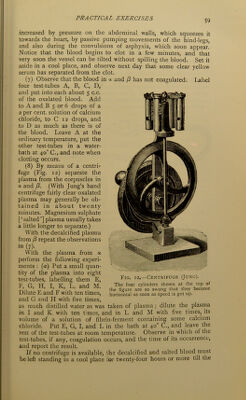
![59 increased by pressure on the abdominal walls, which squeezes it towards the heart, by passive pumping movements of the hind-legs, and also during the convulsions of asphyxia, which soon appear. Notice that the blood begins to clot in a few minutes, and that very soon the vessel can be tilted without spilling the blood. Set it aside in a cool place, and observe next day that some clear yellow serum has separated from the clot. (7) Observe that the blood in a and (3 has not coagulated. Label four test-tubes A, B, C, D, and put into each about 5 c.c. of the oxalated blood. Add to A and B 5 or 6 drops of a 2 per cent, solution of calcium chloride, to C 12 drops, and to D as much as there is of the blood. Leave A at the ordinary temperature, put the other test-tubes in a water- bath at 40° C., and note when clotting occurs. (8) By means of a centri- fuge (Fig. 12) separate the plasma from the corpuscles in a and (3. (With Jung’s hand centrifuge fairly clear oxalated plasma may generally be ob- tained in about twenty minutes. Magnesium sulphate [‘ salted ’] plasma usually takes a little longer to separate.) With the decalcified plasma from (3 repeat the observations in (7). With the plasma from a perform the following experi- ments : (a) Put a small quan- tity of the plasma into eight test-tubes, labelling them E, F, G, H, I, K, L, and M. Dilute E and F with ten times, and G and H with five times, as much distilled water as was taken of plasma; dilute the plasma in I and K with ten times, and in L and M with five times, its volume of a solution of fibrin-ferment containing some calcium chloride. Put E, G, I, and L in the bath at 40° C., and leave the rest of the test-tubes at room temperature. Observe in which of the test-tubes, if any, coagulation occurs, and the time of its occurrence, and report the result. If no centrifuge is available, the decalcified and salted blood must be left standing in a cool place for twenty-four hours or more till the Fig. 12.—Centrifuge (Jung). The four cylinders shown at the top of the figure are so swung that they become horizontal as soon as speed is got up.](https://iiif.wellcomecollection.org/image/b21932967_0065.jp2/full/800%2C/0/default.jpg)