A manual of palaeontology for the use of students : with a general introduction on the principles of palaeontology / by Henry Alleyne Nicholson and Richard Lydekker.
- Date:
- 1889
Licence: Public Domain Mark
Credit: A manual of palaeontology for the use of students : with a general introduction on the principles of palaeontology / by Henry Alleyne Nicholson and Richard Lydekker. Source: Wellcome Collection.
Provider: This material has been provided by the Royal College of Physicians of Edinburgh. The original may be consulted at the Royal College of Physicians of Edinburgh.
47/1688 page 25
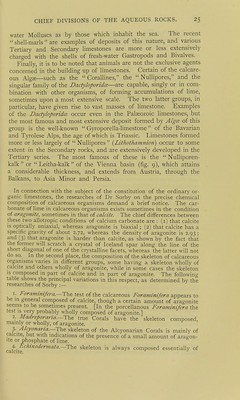
![water Molluscs as by those which inhabit the sea. The recent shell-marls are examples of deposits of this nature, and various Tertiary and Secondary limestones are more or less extensively charged with the shells of fresh-water Gastropods and Bivalves. Finally, it is to be noted that animals are not the exclusive agents concerned in the building up of limestones. Certain of the calcare- ous Alg^—such as the CoraUines, the NuUipores, and the singular family of the Dadyloporidce—are capable, singly or in com- bination with other organisms, of forming accumulations of lime, sometimes upon a most extensive scale. The two latter groups, in particular, have given rise to vast masses of limestone. Examples of the Dadyloporidce occur even in the Palaeozoic limestones, but the most famous and most extensive deposit formed by Algce of this group is the well-known Gyroporella-limestone of the Bavarian and Tyrolese Alps, the age of which is Triassic. Limestones formed more or less largely of Nullipores {Lithothaninion) occur to some extent in the Secondary rocks, and are extensively developed in the Tertiary series. The most famous of these is the Nulliporen- kalk or Leitha-kalk of the Vienna basin (fig. 9), which attains a considerable thickness, and extends from Austria, through the Balkans, to Asia Minor and Persia. In connection with the subject of the constitution of the ordinaiy or- ganic limestones, the researches of Dr Sorby on the precise chemical composition of calcareous organisms demand a brief notice. The car- bonate of lime in calcareous organisms exists sometimes in the condition of aragonite, sometimes in that of calcite. The chief differences between these two allotropic conditions of calcium carbonate are : (i) that calcite is optically uniaxial, whereas aragonite is biaxial; (2) that calcite has a specific gravity of about 2.72, whereas the density of aragonite is 2.93 ; and (3) that aragonite is harder than calcite, as shown by the fact that the former will scratch a ciystal of Iceland spar along the line of the short diagonal of one of the crystalline facets, whereas the latter will not do so. In the second place, the composition of the skeleton of calcareous organisms varies in different groups, some having a skeleton wholly of calcite and others wholly of aragonite, while in some cases the skeleton IS composed in part of calcite and in part of aragonite. The following table shows the principal variations in this respect, as determined by the researches of Sorby :— 1. Foramini/era.~Th& test of the calcareous Foraminifera appears to be in general composed of calcite, though a certain amount of aragonite seems to be sometimes present. [In the porcellanous Foraminifera the test is very probably wholly composed of aragonite.] 2. Madreporaria.~'Y\^& true Corals have the skeleton composed, mainly or wholly, of aragonite. 3. ^/^d7«ar/rt.—The skeleton of the Alcyonarian Corals is mainly of calcite, but with indications of the presence of a small amount of aragon- 4. Fchiiioder>nata.~T\\e skeleton is always composed essentially of](https://iiif.wellcomecollection.org/image/b21932839_0047.jp2/full/800%2C/0/default.jpg)



 No text description is available for this image
 No text description is available for this image
 No text description is available for this image