Morse's patent : full exposure of Dr. Chas. T. Jackson's pretensions to the invention of the American electro-magnetic telegraph / by Amos Kendall.
- Amos Kendall
- Date:
- 1852
Licence: Public Domain Mark
Credit: Morse's patent : full exposure of Dr. Chas. T. Jackson's pretensions to the invention of the American electro-magnetic telegraph / by Amos Kendall. Source: Wellcome Collection.
Provider: This material has been provided by the National Library of Medicine (U.S.), through the Medical Heritage Library. The original may be consulted at the National Library of Medicine (U.S.)
7/64
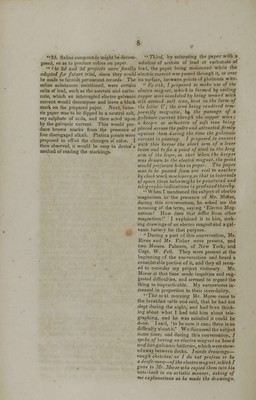
![wrong, and erroneously stated; and some things then remem- bered, he does not now remember at all! lie now remembers, that in the conversation on board the Sully, he described minutely the Electro-Magnetic Telegraph, as it now exists; he remembers that it was not Prof. Morse, but himself, who devised the system of signs; and he does not remember that it was Mr. Fisher or Mr. Rives who first suggested the idea of sending news by elec- tricity. To make more plain the operation ot Dr. Jackson's strong and retentive memory, we place in parallel columns his recollections, as given in 1837 and 1850: All the conversation between Br. The conversation between Br. Jackson. Jackson and Prof. Morse, relating to the and Prof. Blorse, relating to the Telegraph, Telegraph, on hoard the packet ship Sal.li/, on board the packet ship Sally, in 1832, as in 1832, as given in the letter of Br. Jack- gk>en in Br. Jackson's deposition in the son to Prof. JMorse, dated Nov. 7,1837: case of Smith vs. Downing, £c, in 1850 : Now, in what manner did the discovery While on the voyage, one day at table, and invention arise, and to whom are the I introduced the subject of electricity and suggestions due? I was enthusiastically de- electro-magnetism, describing an experiment scribing the curiousand wonderful properties of Pouillet, of sending electricity a great of electricity and electro magnetism before many times around the Academy of the yourself, Mr. Rives, Mr. Fisher, and others, Sorbonne, without any perceptible loss sf at table, after dinner, while the company time. There being some expressions of in- here all listeners, and, as appeared to me, credulity, I endeavored to enforce the fact were somewhat incredulous, they knowing by alluding to Franklin's experiment of little or nothing of the subject. I mentioned, transmitting an electric spark to a great dis- amonn- other things, that I had seen the tance, using a wire and water as conductors, electric spark pass instantaneous, without Mr. Morse asked in which of Franklins any appreciable loss of time, four hundred works it was contained, and stated he had times around the great lecture room of the never read it. I stated I believed it was in Sorbonne. This evidently surprised the his autobiography. After some discussion comoanv and I then asked if they had not on the point, one of the passengers said, read of Dr Franklin's experiment, in which «It would be well if we could send news in he caused electricity to go a journey of 20 this rapid manner.' This was a casual re- miles by means of a wire stretched up the mark in allusion to our earnest desire to Thames, the water bein- made a part of the hear from home, as there was some appre- circuit? The answer was from yourself, hension of a war with France. Mr. Morse that you had not read it. After a short dis- said 'Why cant we> I immediately re- -ussion as to the instantaneous nature of the plied, «We can; there is no difficulty about nassa-e one of the party, either Mr. Rives it;' and then proceeded to describe various ITmt Fhher, said it would be well if we methods by which I conceived that intellt- could send news in the same rapid manner, gen.ee might be transmitted by electricity To which you replied, ' Why can't we?' I and electro-magnetism, then proceeded to inform you, in answer to vour question, how it might be done: m^j^ y l«t I observed that electricity might* First, I proposed to count the spa ks made visible in any part of the circuit, by in a disjoined wire c.rcuit-counttng the £ Sin- he wire, when a spark would be ^arks in t.me-that is, counting or noting seen at°the intersection. the sparks and the Interval* between the sparks. «2d That it could be made to perforate Second, by producing colored markson «at,er if interposed between the disconnect- prepared paper, he paper being saturated papa ij imerjjuacu ^.^ an eagily ,]ecomp0saule neutral salt, ed wires. anj sta;nej wjtn tumeric, or some other easily changed vegetable.color.](https://iiif.wellcomecollection.org/image/b21134492_0007.jp2/full/800%2C/0/default.jpg)