Infancy and infant-rearing : an introductory manual / by John Benjamin Hellier.
- Hellier, John Benjamin.
- Date:
- 1895
Licence: Public Domain Mark
Credit: Infancy and infant-rearing : an introductory manual / by John Benjamin Hellier. Source: Wellcome Collection.
Provider: This material has been provided by University of Bristol Library. The original may be consulted at University of Bristol Library.
83/164 page 69
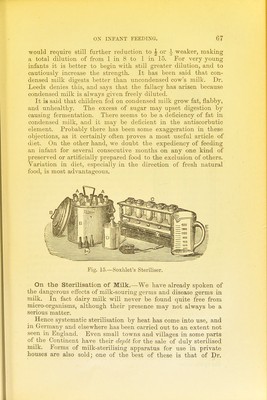
![4. After the water has boiled briskly for three-quarters of an hour, the steam escaping all the time from the edge of the lid, the lid is removed and the flask holder lifted out. As the flasks cool, the atmospheric pressure, acting on the discs, seals the flasks hermetically. 5. For use one flask is warmed to blood heat in the small vessel, a process which frequent shaking facilitates. When the flask feels neither hot nor cold when laid upon the eyelid, it is ready for use. The disc is then removed by tilting up one edge, the teat is applied to the flask, and the child fed directly from it. 6. So long as the discs remain depressed the flasks are fit for use. When one has been opened, any unused remnant must be, thrown away; but a closed flask will keep two or three days. 7. After use the flasks must be at once filled with water, so- that no drop of milk can dry upon the interior. They must be- cleaned with the brush, and some alkaline carbonate may be used for the ])urpose. The discs also must be thoroughly washed in water. Tliey last longer if every four weeks they are boiled in soda solution. Pasteurisation.—There is a modified process of milk sterili- sation called pasteurisation, which is advocated by some. This consists in heating the milk to from 160° to 170° F. for ten or twenty minutes. This heat does not coagulate the lact-albumen. It is sufiicient to destroy the germs of tuberculosis, scarlet fever, typhoid, and pneumonia, and to inhibit the development of bacteria, although it does not actually destroy all spores as the^ higher temperature does. This alters the taste of the milk less than the other process. If it be wished to keep the milk longer than twenty-four hours, especially in hot weathei', the higher temperature is more effective (Hotch). To pasteurise with Soxhlet's apparatus, only an inch or so of water is put in the vessel, and the boiling is coutinued twenty minutes, with the lid loosely fitted on. It cannot be said that a final conclusion has been reached on the subject of milk sterilisation. The question is still under discussion.* Sterilisation may fail to produce healthy milk if the milk has begun to decompose befoi-e sterilisation; and the precautions necessary to be taken at the milking-sheds and dairy to prevent contamination of the milk are very stringent. It is difiicult also to cleanse the bottles perfectly, and some authorities question the wholesomeness of sterilised milk and dispute its * See, for example, Cassell's Year-hool- of treatment, 1894, and a series of '- Abstracts in the Medical Chronicle, April and May, 1894.](https://iiif.wellcomecollection.org/image/b21439795_0083.jp2/full/800%2C/0/default.jpg)