Volume 1
Report on the origin and spread of typhoid fever in U.S. military camps during the Spanish War of 1898 / by Walter Reed, Victor C. Vaughan and Edward O. Shakespeare.
- Walter Reed
- Date:
- 1904
Licence: Attribution-NonCommercial 4.0 International (CC BY-NC 4.0)
Credit: Report on the origin and spread of typhoid fever in U.S. military camps during the Spanish War of 1898 / by Walter Reed, Victor C. Vaughan and Edward O. Shakespeare. Source: Wellcome Collection.
Provider: This material has been provided by London School of Hygiene & Tropical Medicine Library & Archives Service. The original may be consulted at London School of Hygiene & Tropical Medicine Library & Archives Service.
769/778 page 717
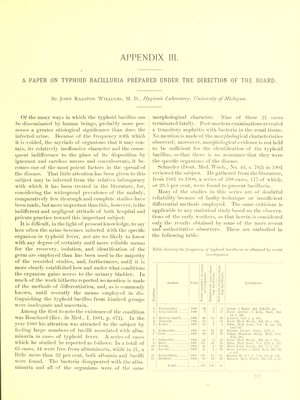
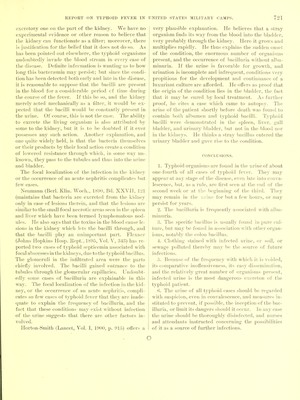
![APPENDIX III. A PAPER ON TYPHOID BACILLURIA PREPARED UNDER THE DIRECTION OF THE BOARD. By John Ralston Williams, M. D., Hygienic Laboratory, University of Michiga7i. Of the many ways in which the typhoid Ijacillus can be dis.seminated by human beings, probably none pos- sesses a greater etiological signiticance than does the infected urine. Because of the frequency with which it is voided, the myriads of organisms that it may con- tain, its relatively inoffensive character and the conse- quent indifference to the place of its disposition by ignorant and careless nurses and convalescents, it be- comes one of the most potent factors in the spread of the disease. That little attention has been given to this subject may be inferred from the relative infrequency with which it has been treated in the literature, for, considering the widespread prevalence of the malady, comparatively few thorough and complete studies have been made, but more important than this, however, is the indifferent and negligent attitude of both hospital and private pi'actice toward this important subject. It is difficult, in the lightof present knowledge, to say how often the urine becomes infected with the specific organism in typhoid fever, nor are we likely to know with any degree of certainty until more reliable means for the recovery, isolation, and identification of the germ are employed than has been used in the majority of the recorded studies, and, furthermore, until it is more clearly established how and under what conditions the organism gains access to the urinarv bladder. In much of the work hitherto reported no mention is made of the methods of differentiation, and, as is commonly known, until recently the means employed in dis- tinguishing the typhoid bacillus from kindred groups were inadequate and uncertain. Among the first to note the existence of the condition was Bouchard (Rev. de Med., I, 1881, p. 071). In the .year 1880 his attention was attracted to the subject by fiiiding large numbers of bacilli associated with albu- minuria in cases of typhoid fever. A series of cases which he studied he reported as follows: In a total of G5 cases, 14 were free from albuminuria, while in 21, a little more than 32 per cent, both albumin and bacilli were found. The bacteria disappeared with the albu- miiuiria and all of the organisms were of the same morphological character. Nine of these 21 cases terminated fatally. Post-mortem examinations revealed a transitory nephritis with bacteria in the renal tissue. No mention is made of the morphological characteristics observed; moreover, morphological evidence is not held to be sufiicient for the identification of the typhoid bacillus, so that there is no assurance that they were the specific organisms of the disease. Schueder (Deut. Med. Woch., No. 11, s. 762) in 1901 reviewed the subject. He gathered from the literature, from 1881 to 1900, a series of 599 cases, 177 of which, or 29.5 per cent, were found to present bacilluria. Many of the studies in this series are of doubtful reliability because of faulty technique or insufficient differential methods employed. The same criticism is applicable to an}^ statistical study leased on the observa- tions of the early workers, so that herein is considered onl^ the results obtained by some of the more recent and authoritati\'c observers. These are embodied in the following table: TahU .sjiowiiig the frequency of typhoid hacUluria ax obtained l>i/ recent ■investigators. 1 Number. 1 Author. Year. Total number of cases investigated. Number of cases show- ing bacilluria. i-ent of cases show- ing bacilluria. Literature. 1 Petruschkv 1898 50 3 6 Centr. f. Bakt., Bd. XXIII, 14. 2 Sc'hichhold 1899 7 5 71 Deut. Archiv. f. Klin. Med., Bd. 64, s. 505. 3 Horton-Smith 1900 39 11 28 Lancet, Vol. 1. p. 915. 4 Neufeld 1900 12 3 25 Deut. Med. Woch,, Bd. 51, s. .S24. 6 Lewis 1901 4.5 1 2 Edin. Med. Jour., Vol. X, pp. 201 and .5t')7. 6 Klimenko 1901 05 13 20 Russky Archiv. Path., XII, 2. 7 Cole 1901 49 17 35 Johns Hopkins Hosp. Bull., Vol. XII. 203. 8 Schueder 1901 22 5 23 Deut. Med. Woch., Bd. 44, s. 7ii2. 9 Bliss 1902 311 31 10 Edin. Med. Jour., Vol. XII, p. 337. 10 Fuchs 1902 41 4 10 Wien Klin. Woch., Bd. l.'i, s. 170. 11 Jaeobi 1902 27 5 19 Deut. Archiv. f. Klin. Med., Bd. 72, s. 442. 12 Richardson 1903 103 22 21 Boston M. it S. J., \'ol. MS, p. 1,V2. ]3 Herbert 1904 98 19 18 Munch. Med. Woch. Bd. LI, s. 11. Total 139 k; 1](https://iiif.wellcomecollection.org/image/b21354443_0002_0769.jp2/full/800%2C/0/default.jpg)

 No text description is available for this image
 No text description is available for this image
 No text description is available for this image