Volume 1
Report on the origin and spread of typhoid fever in U.S. military camps during the Spanish War of 1898 / by Walter Reed, Victor C. Vaughan and Edward O. Shakespeare.
- Walter Reed
- Date:
- 1904
Licence: Attribution-NonCommercial 4.0 International (CC BY-NC 4.0)
Credit: Report on the origin and spread of typhoid fever in U.S. military camps during the Spanish War of 1898 / by Walter Reed, Victor C. Vaughan and Edward O. Shakespeare. Source: Wellcome Collection.
Provider: This material has been provided by London School of Hygiene & Tropical Medicine Library & Archives Service. The original may be consulted at London School of Hygiene & Tropical Medicine Library & Archives Service.
770/778 page 718
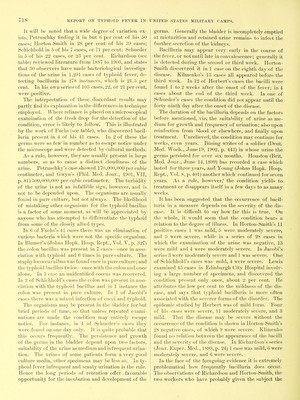
![It will be noted that a wide degree of variation ex- ists, Petruschk}^ finding it in but 6 per cent of his 60 cases; Horton-Smith in 28 per cent of his 39 cases; Schichhold in 5 of his 7 cases, or 71 per cent; Schueder in 5 of his 22 cases, or 23 per cent. Richardson (see table) reviewed literature from 1887 to 1903, and states that 30 observers have made bacteriological investiga- tions of the virine in 1,291 cases of tj'phoid fever, de- tecting bacilluria in 278 instances, which is 21.5 per cent. In his own series of 103 cases, 22, or 21 per cent, were positive. The interpretation of these discordant results may partly find its explanation in the diilerences in technique employed. Where reliance is placed on a microscopical examination of the fresh drop for the detection of the condition, error is likely to follow. This is illustrated by the work of Fuchs (see table), who discovered bacil- luria present in -i of his 41 cases. In 2 of these the germs were so few in number as to escape notice under the microscope and were detected by cultural methods. As a rule, however, they are usuall}^ present in large numbers, so as to cause a distinct cloudiness of the urine. Petruschky's case showed 170,000,000 per cubic centimeter, and Gwyn's (Phil. Med. Jour., 1901, VII, p. 81) 500,000,000 per cubic centimeter. The turbidity of the urine is not an infallible sign, however, and is not to be depended upon. The organisms are usually found in pure culture, but not always. The likelihood of mistaking other organisms for the tjq^hoid bacillus is a factor of some moment, as will be appreciated by an^'one who has attempted to differentiate the typhoid from some of the closel}^ allied types. In 6 of Fuchs's 41 cases there was an elimination of various bacteria which were not the specific organism. In Blumer's (Johns Hopk. Hosp. Kept., Vol. V, p. 327) the colon bacillus was present in 7 cases—once in asso- ciation with tj'phoid and 6 times in pure culture. The staphylococcus albus was found once in pure culture; and the tj'phoid bacillus twice—once with the colon and once alone. In 1 case an unidentified coccus was recovered. In 2 of Schichhold's cases the colon was present in asso- ciation with the typhoid bacillus and in 1 instance the colon was present in pure culture. In 1 of Jacobi's cases there was a mixed infection of cocci and typhoid. The organisms may be present in the bladder for but brief periods of time, so that unless repeated exami- nations are made the condition may entirely escape notice. For instance, in 4 of Schueder's cases they were found on one day only. It is quite probable that this occurs frequently. The persistence and growth of the germs in the bladder depend upon two factors, suitability of the urine as medium and infrequent urina- tion. The urines of some patients form a very good culture media, other specimens may be less so. In ty- phoid fever infrequent and scanty urination is the rule. Hence the long periods of retention offer favorable opportunity for the incubation and development of the germs. Generally the bladder is incompletely emptied at mictui-ition and retained urine remains to infect the further secretion of the kidneys. Bacilluria may appear very early in the course of the fever, or not until late in convalescence; generallj^it is detected during the second or third week. Horton- Smith discovered it in 1 case on the eighth day of the disease. Kilmenko's 13 cases all appeared before the third week. In 12 of Herbert's cases the bacilli were found 1 to 2 weeks after the onset of the fever; in 4 cases about the end of the third week. In one of Schueder's cases the condition did not appear until the forty-ninth day after the onset of the disease. The duration of the bacilluria depends on the factors before mentioned, viz, the suitability of urine as me- dium for growth and frequency of urination; also upon reinfection from blood or elsewhere, and finally upon treatment. Unrelieved, the condition may continue for weeks, even years. Busing writes of a soldier (Deut. Med. Woch., June 19, 1902, p. 443) in whose urine the germs persisted for over six months. Houston (Brit. Med. Jour., June 14,1899) has recorded a case which lasted for three years, and Young (Johns Hopk. Hosp. Rept., Vol. 8, p. 401) another which continued for seven years. As a rule, however,' the condition yields to treatment or disappears itself in a few days to as many weeks. It has been suggested that the occurrence of bacil- luria in a measure depends on the severity of the dis- ease. It is difficult to say how far this is true. On the whole, it would seem that the condition bears a relation to the degree of illness. In Horton-Smith's 11 positive cases 1 was mild, 5 were moderately severe, and 5 were severe, while in a series of 28 cases in which the examination of the urine was negative, 13 were mild and 4 were moderately severe. In Jacobi's series 3 were moderatel}^ severe and 1 was severe. One of Schichhold's cases was mild, 4 were severe. Lewis examined 45 cases in Edinburgh City Hospital involv- ing a large number of specimens, and discovered the condition present only once, about 2 per cent. He attributes the low per cent to the mildness of the dis- ease, and says that typhoid bacilluria is more often associated with the severer forms of the disorder. The epidemic studied by Herbert was of mild form. Four of his cases were severe, 11 moderately severe, and 3 mild. That the disease may be severe without the occurrence of the condition is shown in Horton-Smith's 28 negative cases, of which 9 wei'e severe. Klimenko found no ]-elation between the appearance of the bacilli and the severity of the disease. In Richardson's series (Jour. Exper. Med., 1899, p. 24) 1 case was mild, 6 were moderately severe, and 6 were severe. In the face of the foregoing evidence it is extremely problematical how frequently bacilluria does occur. The observations of Richardson and Horton-Smith, the two workers who have probably given the subject the](https://iiif.wellcomecollection.org/image/b21354443_0002_0770.jp2/full/800%2C/0/default.jpg)

 No text description is available for this image
 No text description is available for this image
 No text description is available for this image