Volume 1
Report on the origin and spread of typhoid fever in U.S. military camps during the Spanish War of 1898 / by Walter Reed, Victor C. Vaughan and Edward O. Shakespeare.
- Walter Reed
- Date:
- 1904
Licence: Attribution-NonCommercial 4.0 International (CC BY-NC 4.0)
Credit: Report on the origin and spread of typhoid fever in U.S. military camps during the Spanish War of 1898 / by Walter Reed, Victor C. Vaughan and Edward O. Shakespeare. Source: Wellcome Collection.
Provider: This material has been provided by London School of Hygiene & Tropical Medicine Library & Archives Service. The original may be consulted at London School of Hygiene & Tropical Medicine Library & Archives Service.
93/778 page 69
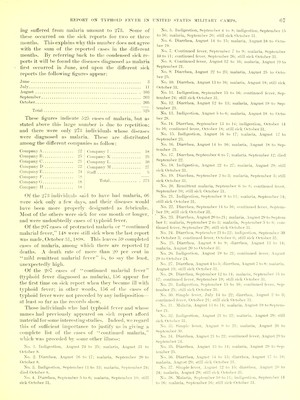
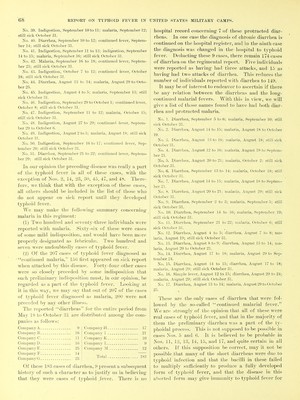
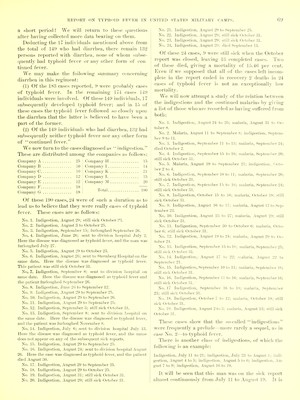
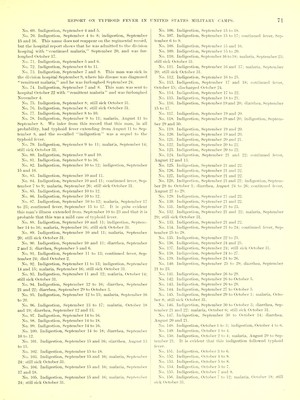
![a short period? Wc will return to these ({uestions after having collected more data bearing on them. Deducting the IT indi\ iduals mentioned above from the total of liU who had diarrhea, there remain 132 persons reported with diai'rlioa, none of whom sul)se- quentlv had typhoid fever or any other form of con tinned fever. We may make the following sunnnary concerning diarrhea in this regiment: (1) Of the 183 cases reported, 9 were probably cases of typhoid fever. In the remaining 174 cases 1-19 individuals weie involved. Of these 119 individuals, 17 subsequently developed typhoid fever; and in 15 of these cases the typhoid fever followed so closely upon the diarrhea that the latter is believed to have been a part of the former. (2) Of the 119 individuals who had diarrhea, 132 had subsequently neither typhoid fever nor any other form of continued fever. We now turn to the cases diagnosed as indigestion/' These are distributed among the companies us follows: Company A 25 j Company 11 15 Company B 10 Company C 10 Comiiany D 12 Company E 12 Company F 18 Company G 18 Company 1 14 Company K 21 Company 1j 15 Company SI 20 Total 190 Of these 190 cases, 21 were of such a duration as to lead us to believe that they were really cases of typhoid fever. These cases are as follows; No. 1. Indigestion, August 29; still sick October No. 2. Indigestion, August 3 to October 25. No. o. Indigestion, SeptemVjer 15; furloughed September 26. No. 4. Indigestion, June 26; sent to division hospital July 2. Here the disease was diagnosed as typhoid fever, and the man was furloughed July 27. No. 5. Indigestion, August 29 to October 2:i. No. 6. Indigestion, August 26; sent to Stei'nberg Hospital on the same date. Here the disease was diagnosed as typhoid fever. This patient was still sick October .31. No. 7. Indigestion, September 8; sent to division liospital on same date. Here the disease was diagnoses! as typlKjid fever and the patient furloughed September 26. No. 8. Indigestion, June 26 to September 12. No. 9. Indigestion, August 29 to September 25. No. 10. Indigestion, August 29 to September 26. No. 11. Indigestion, August 29 to September 25. No. 12. Indigestion, September 3; still sick October 81. No. 13. Indigestion, September 8; sent to division hospital on the same date. Here the disease was diagnosed as typhoid fever, and the patient was furloughed November 8. No. 14. Indigestion, July 6; sent to division hospital July 13. Here the disease was diagnosed as t3'phoid fever, and the name does not appear on any of the subsequent sick reports. No. 15. Indigestion, August 29 to September 25. No. 16. Indigestion, August 24; sent to division hospital August 26. Here the case was diagnosed as typhoid fever, and the jiatient died August 30. No. 17. Indigestion, August 29 to September 25. No. 18. Indigestion, August 29 to October 25. No 19. Indigestion, August 31; still sick October 31. No. 20. Indigestion, August 29; still sick October 31. No. 21. Indigestion, August 29 to September 25. No. 22. Indigestion, August 29; still sick ()ctol)er 31. No. 23. Indigestion, August 29; still sick (;)ctober 31. N(i. 24. Indigestion, August 29; died Septeml>er 13. Of these 24 cases, 9 were still sick when the October report was closed, leaving 13 completed cases. Two of these died, giving a mortality of 15.46 per cent. Even if we supposed that all oi the cases left incom- plete in the report ended in recoverv 2 deaths in 24 cases of tvphoid fever is not an exceptionally low mortality. We will now attempt a study of the relation between the indigestions and the contiiuied malarias by giving a list of those who are recorded as having sutfei'ed from both: No. 1. Indigestion, August 24 to 25; malaria, August 31 to Oc- tol )er 8. No. 2. Malaria, August 11 to, Septem))er s; indigestion, Septem- ber 9 to 11. No. 3. Indigestion, Septenil)er 11 to IK; malaria, Septcnilii-r 24; died Octol)er 2. No. 4. Indigestifin, Seiiteniher 15 to 16; malaria, Seiiteuiller 20; still sick October 31. No. 5. Malaria, August 19 to September 21; indigestion. Octo- ber 2 to 4. No. 6. Indigestion, September 1(1 to 11; malaria, St-pteniber 26; still sick Octol)er 31. No. 7. Iniligestion, September 15 to Ki; malaria, Sejitembor 24; still sick October 31. No. 8. Indigestion, October 15 to Ki; malaria, Octolier IS; still sick October m. No. 9. Indige.stion, August 16 to 17; malaria, August 1 7 to Sep- tember 23. No. 10. In<ligestiou, August 23 to 27; malaria, August 29; still sick Octol ier 31. No. 11. Indigestion, Septeml)er 30 to <-)ctober 6; malaria, ()cto- ber 6; still sick October 31. No. 12. Indigestion, August 19 to 24; malaria, August 29 tfi Oc- tolier 24. No. 1.'!. Indigestion, September 15 to Kl; malaria, September 25; still sick ( K'tolier 31. No. 14. Indigestion, August 17 to 22; malaria, .Vngust 22 to September 21. No. 15. Indigestion, Sejitember 10 to 11; malaria, Septemlier 16; still sick October 31. No. 16. Indigestion, Septemlier 11 to 16; malai'ia, Scptemliei'16; still sick October 31. • No. 17 Indigestion, September Ki to ]S; malaria, Sejitember 23; still sick (Ictober 31. No. 18. Indigestion, October 7 to li'; malaria, Octolier 18; still sick October 31. No. 19. Indigestion, August 2 to 3; malaria, August 13; still sick October 31. These ca.ses show that the so-called indigestions' were frequently a prelude—more rarely a sequel, as in case No. 2—to typhoid fever. There is another class of indigestions, of which the following is an example: Indigestion, July 11 to 21; indigestion, July 23 to August 1; indi- gestion, August 4 to 5; indigestion, August 5 to 6; indigestion, .\u- gust 7 to 9; indigestion, August bi to 19. It will be seen that this man was on the sick report almost continuousiv from .Iidy 11 to Auynst 19. It is](https://iiif.wellcomecollection.org/image/b21354443_0002_0093.jp2/full/800%2C/0/default.jpg)


 No text description is available for this image
 No text description is available for this image
 No text description is available for this image