Paralyses : cerebral bulbar and spinal: a manual of diagnosis for students and practitioners.
- Henry Charlton Bastian
- Date:
- 1886
Licence: Public Domain Mark
Credit: Paralyses : cerebral bulbar and spinal: a manual of diagnosis for students and practitioners. Source: Wellcome Collection.
Provider: This material has been provided by UCL Library Services. The original may be consulted at UCL (University College London)
651/732 page 627
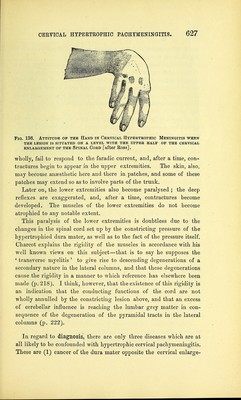
![Fig. 136. Attitude op the Hand in Cervical Hypertrophic Meningitis when the lesion 18 situated on a level with the upper half of the cervical ENLARGEMENT OF THE SPINAL CORD fafter ROSS]. wholly, fail to respond to the faradic current, and, after a time, con- tractures begin to appear in the upper extremities. The skin, also, may become anaesthetic here and there in patches, and some of these patches may extend so as to involve parts of the trunk. Later on, the lower extremities also become paralysed ; the deep reflexes are exaggerated, and, after a time, contractures become developed. The muscles of the lower extremities do not become atrophied to any notable extent. This paralysis of the lower extremities is doubtless due to the changes in the spinal cord set up by the constricting pressure of the hypertrophied dura mater, as well as to the fact of the pressure itself. Charcot explains the rigidity of the muscles in accordance with his well known views on this subject—that is to say he supposes the *■ transverse myelitis ' to give rise to descending degenerations of a secondary nature in the lateral columns, and that these degenerations cause the rigidity in a manner to which reference has elsewhere been made (p. 218). I think, however, that the existence of this rigidity is an indication that the conducting functions of the cord are not wholly annulled by the constricting lesion above, and that an excess of cerebellar influence is reaching the lumbar grey matter in con- sequence of the degeneration of the pyramidal tracts in the lateral columns (p. 222). In regard to diagnosis, there are only three diseases which are at all likely to be confounded with hypertrophic cervical pachymeningitis. These are (1) cancer of the dura mater opposite the cervical enlarge-](https://iiif.wellcomecollection.org/image/b21270478_0651.jp2/full/800%2C/0/default.jpg)



 No text description is available for this image
 No text description is available for this image
 No text description is available for this image