Volume 3
Descriptive catalogue of the pathological specimens contained in the Museum of the Royal College of Surgeons of England.
- Royal College of Surgeons of England. Museum
- Date:
- 1882-
Licence: Public Domain Mark
Credit: Descriptive catalogue of the pathological specimens contained in the Museum of the Royal College of Surgeons of England. Source: Wellcome Collection.
26/568 page 16
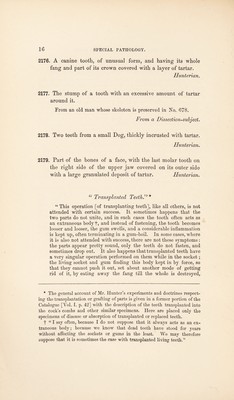
![2176. A canine tooth, of unusual form, and having its whole fang and part of its crown covered with a layer of tartar. Hunterian. 2177. The stump of a tooth with an excessive amount of tartar around it. From an old man whose skeleton is preserved in No. 678. From a Dissection-subject. 2178. Two teeth from a small Dog, thickly incrusted with tartar. Hunterian. 2179. Part of the bones of a face, with the last molar tooth on the right side of the upper jaw covered on its outer side with a large granulated deposit of tartar. Hunterian. “ Transplanted TeethF * “ This operation [of transplanting teeth], like all others, is not attended with certain success. It sometimes happens that the two parts do not unite, and in such cases the tooth often acts as an extraneous body f, and instead of fastening, the tooth becomes looser and looser, the gum swells, and a considerable inflammation is kept up, often terminating in a gum-boil. In some cases, where it is also not attended with success, there are not these symptoms : the parts appear pretty sound, only the teeth do not fasten, and sometimes drop out. It also happens that transplanted teeth have a very singular operation performed on them while in the socket; the living socket and gum finding this body kept in by force, so that they cannot push it out, set about another mode of getting rid of it, by eating away the fang till the whole is destroyed, * The general account of Mr. Hunter’s experiments and doctrines respect¬ ing the transplantation or grafting of parts is given in a former portion of the Catalogue [Yol. I. p. 42] with the description of the teeth transplanted into the cock's combs and other similar specimens. Here are placed only the specimens of disease or absorption of transplanted or replaced teeth. f “ I say often, because I do not suppose that it always acts as an ex¬ traneous body; because we know that dead teeth have stood for years without affecting the sockets or gums in the least. We may therefore suppose that it is sometimes the case with transplanted living teeth.”](https://iiif.wellcomecollection.org/image/b29334718_0003_0026.jp2/full/800%2C/0/default.jpg)



 No text description is available for this image
 No text description is available for this image
 No text description is available for this image