Cerebral psychology : read at a meeting of the Psychological Society of Great Britain / by Charles Bray.
- Charles Bray
- Date:
- [1877?]
Licence: Public Domain Mark
Credit: Cerebral psychology : read at a meeting of the Psychological Society of Great Britain / by Charles Bray. Source: Wellcome Collection.
Provider: This material has been provided by The Royal College of Surgeons of England. The original may be consulted at The Royal College of Surgeons of England.
5/12 page 5
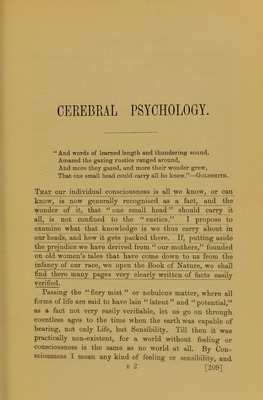
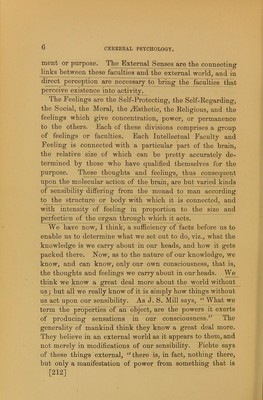
![bility or feeling through the nervous system we find that the brain of a fish bears about the average proportion to the spinal cord of 2 to 1; of the reptile, of 2^ to 1 ; the bird, 3 to 1 ; the animal, 4 to 1; and men, 23 to 1. By a careful comparison of function with development or structure, we have been able to ascertain what thoughts and feelings are connected with each part of the brain as it increases in complexity and size. I know this is denied, and all that the leading Physiologists of the present day admit is, that all thought and feeling is connected with the molecular action of the brain. It is said Phrenology is not a certain science; it appears, however, to me, after forty years study, to be quite as certain as any other department of Physiology; and that the functions of the brain are as well or better known than the functions of any other part of the body. What knowledge of any part of the body can yet be said to be certain science ? But leaving every one to form his own opinion of our cerebral Physiology according to his ignorance or know- ledge of the subject, I wish to point out the Psychology, or Phrenology, or Science of Mind, that has been based upon it, and which has been acknowledged even by opponents to be the only one that is generally recognised, or has any numerous class of followers. According to this system the Intellectual Faculties which perceive existence are, Individuality, Form, Size, Weight, and Colour. The Intellectual Faculties which perceive the relation of external objects are Locality, Number, Order, Eventuality, Time, Tune, and Language, which latter faculty gives a facility in acquiring a knowledge of, and a power of invent- ing, arbitrary signs, or sounds to express thought. i The Reflective Faculties of Comparison, Causality, and Congruity, compare, judge, discriminate, and trace adiust- [2H]](https://iiif.wellcomecollection.org/image/b22443940_0007.jp2/full/800%2C/0/default.jpg)