Children at play / Department of the Environment.
- Department of the Environment, Transport and the Regions
- Date:
- 1973
Licence: Open Government Licence
Credit: Children at play / Department of the Environment. Source: Wellcome Collection.
57/118 page 53
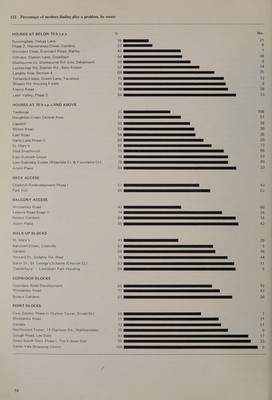
![play The views of mothers 120. Two-thirds of all the mothers interviewed (paragraph 10) found their children’s play either a ‘great problem’ or ‘rather a problem’ (Figure 121). There was considerable variation in attitudes within all types of building form, showing that as with other aspects'?-'* the character and success of individual schemes is not necessarily determined by physical factors (Figure 122). However, it did seem that at all densities their children’s play was less of a problem for mothers living in houses (Figure 123).* 121 Attitudes of the different household types to play % {nae A great problem Rather a problem No problem 47 (UNIT TTT TTT ara o| 0 8 TM | Don’t know/No feelings either way No. Households with children under five years old pro Neha | 774 Households with children aged five to 15 years ho] ©8628 Adult households COM 1.276 [eee }i1, 076 Elderly households The fact that play was significantly less of a problem for mothers living at lower than at higher densities (Figure 124) was partly due to the prevalence of houses at these lower densities. 121. At densities of over 120 bspa, where it is more difficult to accommodate families in houses, no one type of building form emerged as more satisfactory than any other one, and dwellings on the tenth or higher floors were no more likely to produce prob- lems than those between the first and the tenth. In general multi- storey schemes, except those with deck access, produced more problems than schemes with only houses. However, as there were only two schemes in the sample with deck access it would perhaps be rash to conclude that at very high densities mothers will find play less of a problem in deck-access schemes. The only conclusions that can be drawn are that not only do children play out more if they live on the ground, but their mothers too will find their children’s play less of a problem. 122. Figure 125 shows the types of play problem experienced by mothers. Overwhelmingly the main cause of complaint was the lack of play facilities near at hand. ‘There is nowhere for the children to play’ was also a frequent grumble. Two-thirds of the mothers felt that the facilities on or near their own estate were unsatisfactory. When they were asked how things could be im- proved, far the greatest demand was for more and better play areas near to home (Figure 126). The Building Research Station research showed that until children are about nine or ten a great many of them are not allowed off the estate by themselves.7’* Even in Stevenage where many of the areas are traffic-segregated, Holme and Massie found that almost two-fifths of the under-tens were not allowed out alone.* 123. However, one should avoid the temptation of concluding that providing play areas on estates would solve all the play problems mothers admit to. Where play facilities had been pro- vided they did not significantly reduce the number of housewives finding play a problem though they were less likely to complain that the facilities were inadequate. In fact a wide range of seem- ingly relevant variables did not correlate with this issue. T * Many fewer children lived in ground-floor flats than lived in houses or in flats above the ground. Although it did seem that children’s play was more of a problem to mothers in ground-floor flats than in houses it is difficult to know if this would have been confirmed in a larger sample. +The percentages of mothers finding play to be a ‘great problem’ or ‘rather a problem’ did not correlate with: (a) whether estate had play areas or not; (b) whether conventional equipment had been pro- vided or not; (c) whether play provision was regarded as being satis- factory or not; (d) whether children were thought to be safe from traffic or not; (e) whether housewives suffered from ‘nerves’ in the last month or not: (f) whether housewives suffered from undue irritability or not. 2B,](https://iiif.wellcomecollection.org/image/b32222415_0057.jp2/full/800%2C/0/default.jpg)




 No text description is available for this image
 No text description is available for this image
 No text description is available for this image