Medical and sanitary report for the native army of Bombay, for the year 1877. : Framed on the monthly and annual returns, on the reports of regimental medical officers, and on the inspection reports of deputy surgeons general.
- Bombay (Presidency). Military Department.
- Date:
- 1878
Licence: Public Domain Mark
Credit: Medical and sanitary report for the native army of Bombay, for the year 1877. : Framed on the monthly and annual returns, on the reports of regimental medical officers, and on the inspection reports of deputy surgeons general. Source: Wellcome Collection.
Provider: This material has been provided by London School of Hygiene & Tropical Medicine Library & Archives Service. The original may be consulted at London School of Hygiene & Tropical Medicine Library & Archives Service.
20/128 page 2
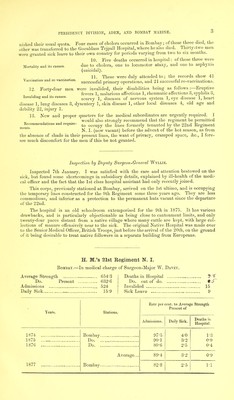
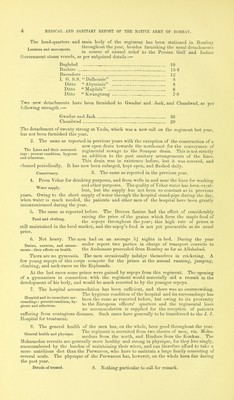
![2. Since tlie 1st of December tlie regiment has occupied the lines previously tenanted by the 9tli Regiment N. I. at Baroda ;* they consist of a number The Lines and their surround- 0f pendals with tiled roofs, the walls being of bamboo plastered aiui otherwisec011 ^11 on’ hygienic inside with mud ; those occupied by married men are divided into rooms, while those occupied by single men are not so •divided, except in some instances by low partitions made by the sepoys themselves; they are fairly well ventilated, but the space afforded per man is much less than that sanctioned by the Government of India (namely, 70 superficial feet for each single man, and 120 for each family), and the men are as uncomfortable and discontented as they can well be. The lines are situate at the N.B. corner of the general parade-ground, in a spot well open to the breeze, but devoid of shade and infested by white ants, and are not to be compared in respect of comfort and individual privacy with those formerly occupied by the 22nd Regiment N. I. while at this station, but now vacant. The drainage of the lines and cantonment and their general sanitary condition are fairly good, and the sanitary condition of the bazaar is satis- factory. The quarter-guard occupied by the regiment is that previously occupied by the 22ud Regiment N. I., and is a very suitable building; it contains two solitary cells, which in respect of cubic space and ventilation are all that can be desired. Conservancy. 3. The system pursued in Bombay was the same as in former years. In Baroda the trench system of latrines is established, two enclosures (for men and women respectively) being situated to the north of the lines : this arrangement is much disliked by the men, and I think must always be practically more or less a failure, as many of the men, sooner than use them, wander into the surrounding country after dusk and defile the ground in the neighbourhood of camp. I believe it is arranged that the permanent latrines (which are now used by the inmates of the hospital only) shall be used by the regiment generally during the rains. 4. In Bombay good and sufficient, from Vehar Lake. At Baroda there are four wells in Water su > >] the lines, which at present yield a sufficiency, but, the rainfall * 1 having been very scanty, it is expected that there will be a scarcity in the hot weather : the water is slightly brackish. 5. Pood was abundant in Bombay, but dearer than in Food. former years. At Baroda supplies are dear compared with Bombay, and of inferior quality. 6. The work performed by the regiment in Bombay was the same as in former years, and does not appear to have had any special effect upon the health the ffV ^ “ average of little over three consecutive nights in bed. At Baroda the duties are fighter; the Residency and Rewa Kanta Jail guards are the only large ones furnished, and the average number of consecutive nights in bed is four aud three-quarters. For exercise the men have their ordinary parades, with running drill in the cold weather. No regular amusements (such as a talimhhana) appear to have been kept up during the year, but sports have occasionally been got up for the men. 7. The hospital at Baroda consists of one large well-raised pendal near the eastern limit of camp, and close to the Guicowaree village of Gowlee Poora: Hospital and its immediate p. about, ninety feet long by twenty broad, capable of holding hygienic and otherwise. comfortably about twenty-lour beds, and having wide verandahs, which can be utilised for extra accommodation. The hospital is clean, well ventilated, and in good repair, and its general hygienic con- dition good. The quarters for medical subordinates are very inferior, being cutcha-built, deficient in space, and badly ventilated; the senior hospital assistant has only one small room and a little cookroom, and there are no quarters for any other medical subordinate. General health and physique. 8. Fairly good. 9. The total admissions into hospital were 568, the average daily number of sick 23-5. . .. . Of the total admissions 206 were due to fevers, chiefly malarial, ot which 13 only were remittent m type. live cases ol small- pox occurred : all recovered. Rheumatism, syphilis, bowel complaints, and contusions fur- * A description of the lines, hospital, &c. &c. occupied by the regiment while stationed at Bombay will be found in the report of the 9th N. L](https://iiif.wellcomecollection.org/image/b24915506_0020.jp2/full/800%2C/0/default.jpg)




 No text description is available for this image
 No text description is available for this image
 No text description is available for this image