Medical and sanitary report for the native army of Bombay, for the year 1877. : Framed on the monthly and annual returns, on the reports of regimental medical officers, and on the inspection reports of deputy surgeons general.
- Bombay (Presidency). Military Department.
- Date:
- 1878
Licence: Public Domain Mark
Credit: Medical and sanitary report for the native army of Bombay, for the year 1877. : Framed on the monthly and annual returns, on the reports of regimental medical officers, and on the inspection reports of deputy surgeons general. Source: Wellcome Collection.
Provider: This material has been provided by London School of Hygiene & Tropical Medicine Library & Archives Service. The original may be consulted at London School of Hygiene & Tropical Medicine Library & Archives Service.
92/128 page 74
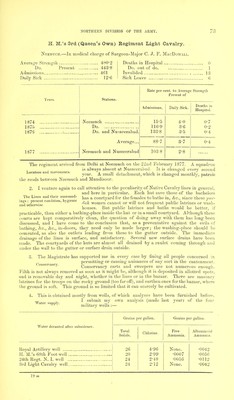
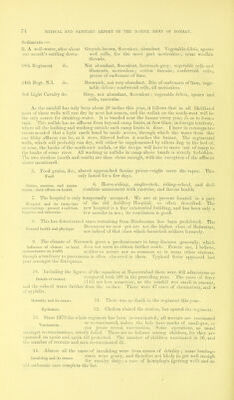
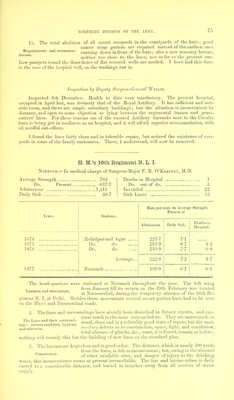
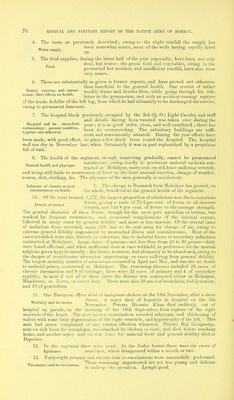
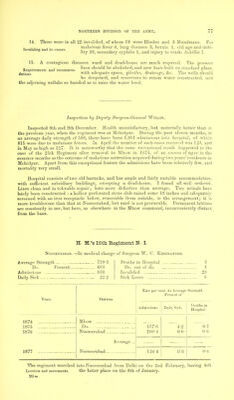
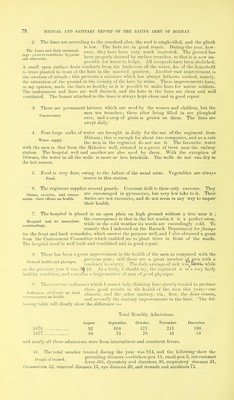
![Sediments :— It. A. well-water, after about one month’s settling: down. 68tli Regiment do. 24tli Read. N.I. do. -3rd Light Cavalry do. Greyish-brown, flocculent, abundant. Vegetabledebris, spores and cells, for the most part motionless; some woollen threads. Not abundant, flocculent, brownish-grey; vegetable cells and filaments, motionless; cotton threads; confervoid cells; pieces of carbonate of lime. Brownish, not very abundant. Bits of carbonate of lime, vege- table debris; confervoid cells, all motionless. Grey, not abundant, flocculent; vegetable debris, spores and cells, naviculae. As the rainfall has only been about 20 inches this year, it follows that in all likelihood most of these wells will run dry by next hot season, and the nullah on the south-west will be the only source for drinking-water. It is bunded near the bazaar every year, so as to form a tank. This nullah has an affluent from beyond camp limits, at Sew Ghat, in foreign territory, •where all the bathing and washing outside such camp limits is done. I have in consequence recommended that a light earth bund be made across, through which the water from this one filthy affluent can be, as it were, filtered before it reaches the bazaar. The regimental wells, which will probably run dry, will either be supplemented by others dug in the bed of, or near, the banks of the north-east nullah, or the troops will have to move out of camp to the banks of some river. All washing in nullahs in camp above bunds is strictly forbidden. The two rivulets (north and south) are thus clean enough, with the exception of the affluent above mentioned. 5. Food grains, &c., almost approached famine prices—eight seers the rupee. Tins Food. only lasted fora few days. Duties, exercise, and amuse- Horse-riding, single-stick, ridmg’-school, and drill ments : their effects on health. combine amusement with exercise, and favour health. 7. The hospital is only temporarily occupied. We are at present located in a part Hospital and its immediate of the old Artillery Hospital, so often described. The surroundings : present condition, new hospital is a fine substantial building, and has been only a hygienic and otherwise. few months in use; its ventilation is good. 8. This has deteriorated since recruiting from Hindoostan General health and physique. has be.en prohibited. The Deccanees we now get are not the higher class of Mahrattas, nor indeed of that class which furnished soldiers formerly. 9. The climate of Meemuch gives a predominance to lung diseases generally, which Influence of climate or local does not seem to obtain further south. Fevers are, I believe, circumstances on health. neither so severe nor so common as in many other stations, though a tendency to pneumonia is often observed in them. Typhoid fever appeared last year amongst the Europeans. 10. Including the figures of the squadron at Nusseerabad there were 46] admissions as compared with 589 in the preceding year. The cases of fever '144! are less numerous, as the rainfall was small in amount Details of treated (144) are less numerous, as and the subsoil water further from the surface. There wer of syphilis. 47 cases of rheumatism, and Mortality and its causes. Epidemics. 18. Since 1878 the whole Vaccination. 11. There was no death in the regiment this year. 12. Cholera visited the station, but spared the regiment. regiment has been re-vaccinated ; all recruits are vaccinated or re-vaccinated, unless the lads have marks of small-pox, cl- ean prove recent vaccination. Some operations, as usual amongst re-vaccinations, utterly failed. There are no failures among children, for they art operated on again and again till protected. The the number of recruits and men re-vaccinated 51 number of children vaccinated is 36, and 14. Almost all the cases of invaliding were from causes of debility ; some lumbago y ]• , • cases were gouty, and therefore not likely to get well enough tor cavalry duty; a case ot hemiplegia (getting well) and an old asthmatic case complete the list.](https://iiif.wellcomecollection.org/image/b24915506_0092.jp2/full/800%2C/0/default.jpg)