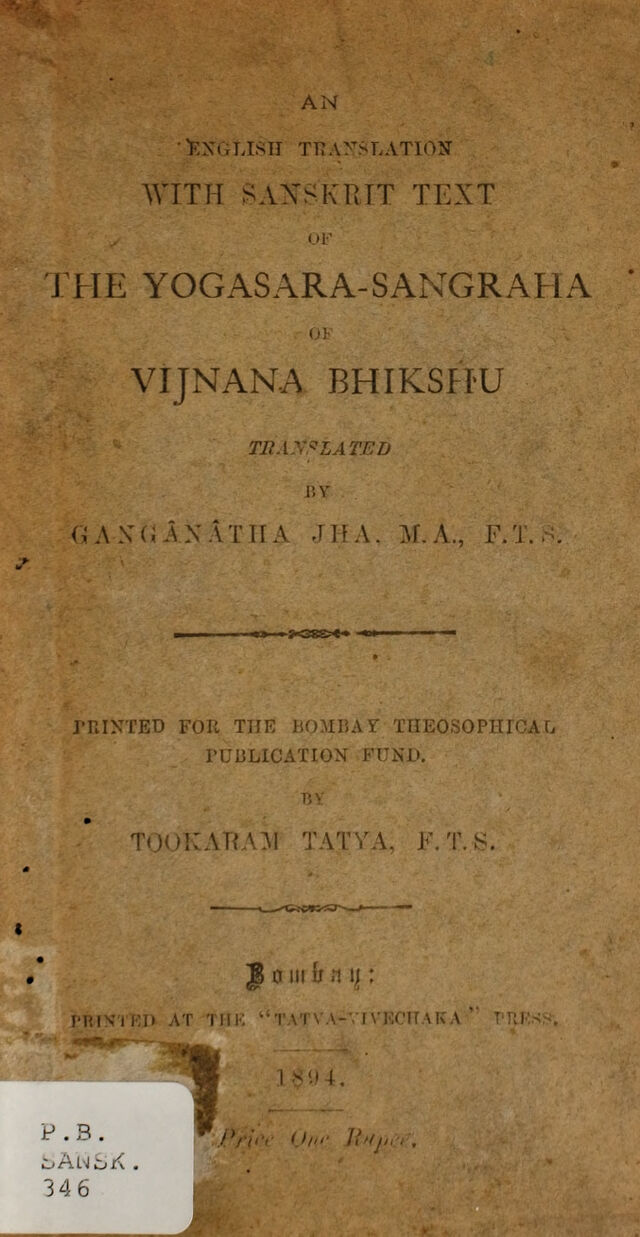
An English translation with sanskrit text of the Yogasara-sangraha / translated by Gangânâtha Jha.
- Vijnanabhiksu
- Date:
- 1894
Licence: Public Domain Mark
Credit: An English translation with sanskrit text of the Yogasara-sangraha / translated by Gangânâtha Jha. Source: Wellcome Collection.
41/198 page 35
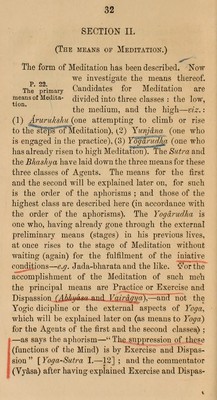
![aud IV—iv]; and again—“Therefore one is to perceive Self (his own individual) in tl^ Self niversal) after having learnt this (foregoing) truth aud having become calm, self-controlled, retired (from the world), forbearing and intent (with his mind fixed upon his one goal) ” \Brikad- aranya ka—lY—iv J. By “Exercise” (or Practice) {Abhya&a) is meant the ‘ endeavour to fix the mind yasSefinl?'’ and this ‘ fixing ’ is the final stage of Meditation and consists^,, streani^atftam^ Says the Bhaga- vadgitd [II.—52] : “ AVhen thy intellect well- versed in Sruti will stand unmoved in Meditation, then wilt thou attain Yoga.” The endeavour for the above-mentioned concentrations consists in the bringing back of the Mind to the I ■ “ ■ object”5f Meditation, whenever it happens to stray aV?ay'from it. As is declared in the Bhrlgdmtl'gifa \_ VI-26 ] : “Whenever the fickle aud mobile Mind moves away, it is to be restrained and chained to the Self.” .Dispassion ( Vdirdgya) consists in the idea of “enough” (with reference to any Vanag?r.defiaed ^^J^ct of enjoyment). _ It is not the ■' mere negation of passion or attach¬ ment; for in that case the epithet “dispassioned” would apply to one who has no passion for an object away from him (aud as such not inviting his atten¬ tion). This Dispassion is of two kinds: Superior (Para) and Inferior (Apara). The inferior kind of Dispassion consists in the absence of desire for](https://iiif.wellcomecollection.org/image/b30094835_0041.jp2/full/800%2C/0/default.jpg)