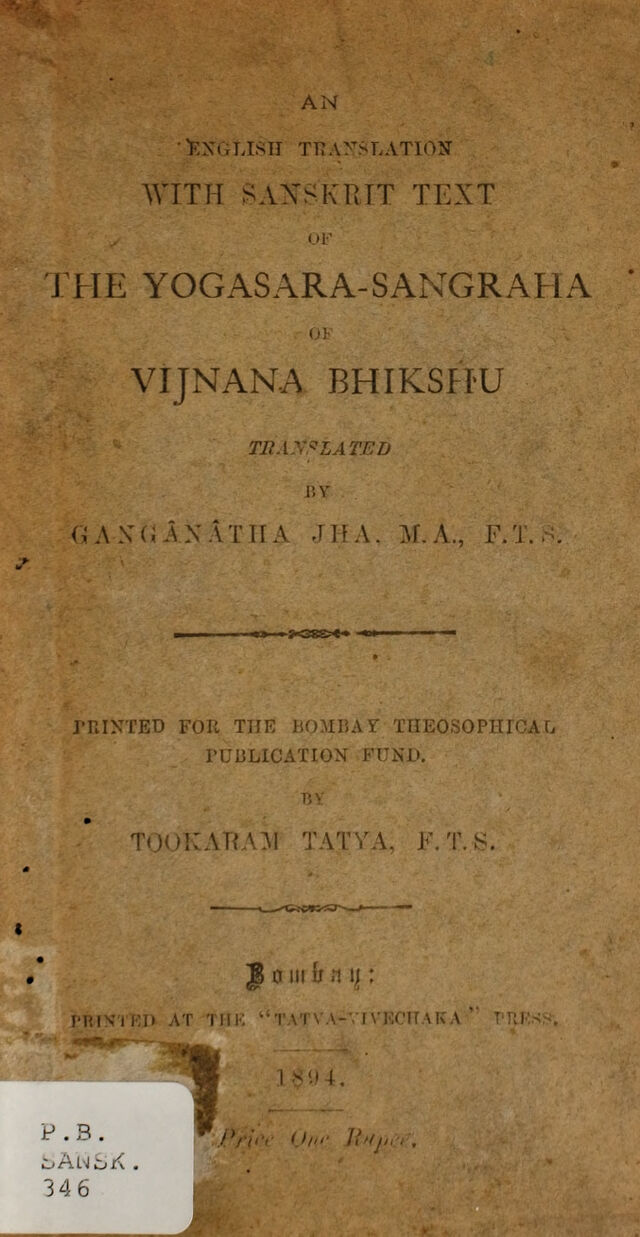
An English translation with sanskrit text of the Yogasara-sangraha / translated by Gangânâtha Jha.
- Vijnanabhiksu
- Date:
- 1894
Licence: Public Domain Mark
Credit: An English translation with sanskrit text of the Yogasara-sangraha / translated by Gangânâtha Jha. Source: Wellcome Collection.
9/198 page 3
![prajmta samddki) is a means of liberation in as much as i^teMs to the perception of the Reality or Essence, and thus puts an end to all troubles of life and the like (which are causes of re-birth &c.). And Unconscious or Abstract Meditation (afawjom- Jndta samdclKi) is also a means of liberation in as much as it destroys the impressions (sanskdra) of all antecedent (mental) functions, and even goes so far as to neglect even Frdrahdha (action of past lives whose fructification has already commenced); [z. e. this unconscious meditation is so very effective that it sets the soul of the agent free even though the fructification of his past Karma has not ended]. All this we have explained at length in the Yoga- mrt^ca [Pada I, Sutras 17 and 18] ; and we shall briefly explain it in this work also later on. The word ‘yoga’ is also applicable in its secondary im¬ plication to the parts of yoga (the different actions that go to make up Yoga) and to the actions of devotion and knowledge, in as much as they are the means to the fulfilment of Yoga; and as such indirectly lead to liberation. Whigh are the mental functions to be suppres- , sed,—and what is meant by “sup- Functions of ’ j i. the thinking pression”? We reply: The five principle. mental functions are: Right notion (*Pramana) Mis-conceptiou {vipai'yaya). Fancy (vikalpa)^ Sleep {nidrd) and Memory(swtrz^z). The suppression of desire and other mental functions follow from the suppression of these. Tlie Right „ . .. notions are: Perception, Inference Correct notions ^ ’ —perception &c. and Right Testimony, The func¬ tioning of the thinking principle —defined.](https://iiif.wellcomecollection.org/image/b30094835_0009.jp2/full/800%2C/0/default.jpg)