Directions for a practical course in chemical physiology / W. Cramer.
- Cramer, William, 1878-1945.
- Date:
- 1920
Licence: In copyright
Credit: Directions for a practical course in chemical physiology / W. Cramer. Source: Wellcome Collection.
45/150 (page 35)
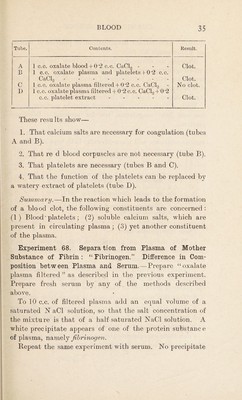
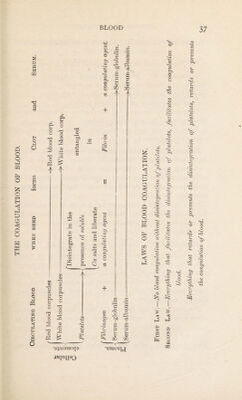
![Tube. Contents. Result. A 1 c.c. oxalate blood+ 0'2 c.c. CaCl2 - Clot. B ] c.c. oxalate plasma and platelets+ 0*2 c.c. CaCL, Clot. C 1 c.c. oxalate plasma filtered+ 0*2 c.c. CaCl2 No clot. D 1 c. c. oxalate plasma filtered + 0 *2 c. c. CaCl2 + 0*2 c.c. platelet extract ..... Clot. These results show— 1. That calcium salts are necessary for coagulation (tubes A and B). 2. That re cl blood corpuscles are not necessary (tube B). 3. That platelets are necessary (tubes B and C). 4. That the function of the platelets can be replaced by a watery extract of platelets (tube D). Summary.—In the reaction which leads to the formation of a bio od clot, the following constituents are concerned : (1 ) Blood’platelets; (2) soluble calcium salts, which are present in circulating plasma; (3) yet another constituent of the plasma. Experiment 68. Separation from Plasma of Mother Substance of Fibrin: ‘‘Fibrinogen.” Difference in Com- position between Plasma and Serum.—Prepare “oxalate plasma filtered ” as described in the previous experiment. Prepare fresh serum by any of the methods described above. To 10 c.c. of filtered plasma add an equal volume of a saturated 1ST aCl solution, so that the salt concentration of the mixture is that of a half saturated NaCl solution. A white precipitate appears of one of the protein substance of plasma, namely fibrinogen. Repeat the same experiment with serum. No precipitate](https://iiif.wellcomecollection.org/image/b29807396_0045.jp2/full/800%2C/0/default.jpg)