Antiseptic surgery : its principles, practice, history and results / by W. Watson Cheyne.
- Watson Cheyne
- Date:
- 1882
Licence: Public Domain Mark
Credit: Antiseptic surgery : its principles, practice, history and results / by W. Watson Cheyne. Source: Wellcome Collection.
507/656 page 471
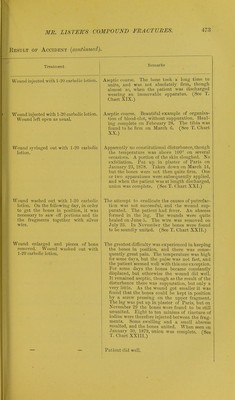
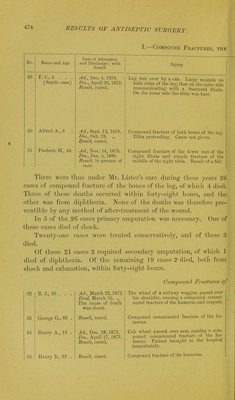
![Result of Accident {continued). 471 Treatment Wound injected with 1-5 solution of car- bolic acid in methylated spirit. Wounds enlarged. Mclntyre splint appUed. Wound injected with a solution of car- bolic acid in methj'lated spirit, 1-5. Remarks Some fragments of bone were removed. The wound was washed out with car- bolic lotion, 1-20. Wound injected with 1-20 carboliclotion. Wound injected with 1-20 carbolic lotion. Wound injected with 1-20 carboliclotion. VVdimd washed out with 1-20 carbolic lotion. Putrefaction avoided. A small abscess formed in the leg and was opened on March 31. Afterwards the wounds progressed weL, and were superficial on May 16. Boracic dressing was then applied. Erysipelas attacked the wound on May 23, but it had passed off on May SO, and the wounds healed rapidly. The bones were quite firm and there were only two super- ficial spots to heal when the patient was dis- charged. Putrefaction was not avoided. The wound suppu- rated freely, and a small piece of bone necrosed. The temperature was not regularly taken, but for twelve davs it was above lOOT., ranging from 100° to 103-9°. The bones had united and the wounds had almost healed when the patient was discharged. Putrefaction was avoided. There was a very little superficial' antiseptic suppuration.' There was no inflammation or formation of abscesses. When discharged the leg was firm, but there was still a sinus leading down to bare bone. The temperature only once rose to 100°, thirty- six hours after the accident. Putrefaction was at first avoided, but the pa- tient, during an attack of delirium tremens, tore off the dressings, and the wound piitrefied. It was henceforth treated with lint soaked in carbolic acid and glj-cerine. When discharged there was still a sinus leading down to bare bone, but the bones w ere quite firm. Putrefaction was not avoided. Two abscesses formed, and the wound and the abscess cavities suppurated. For six weeks the temperature varied from 100° to 10.3° F. Other abscesses formed, but ultimately the parts began to re- cover, and healing was complete at the end of September. Aseptic course. The highest temperature recorded was 99-7°. The wound had healed (exact date not given), and the bones had united ■when the patient was discharged. No constitutional disturbance, but two small fragments lost tlieir vitality, and were not re- moved till a few days before the ])atient was discharged. At that lime the bones were firm, and there remained only a small superficial sore.](https://iiif.wellcomecollection.org/image/b20409928_0509.jp2/full/800%2C/0/default.jpg)