Antiseptic surgery : its principles, practice, history and results / by W. Watson Cheyne.
- Watson Cheyne
- Date:
- 1882
Licence: Public Domain Mark
Credit: Antiseptic surgery : its principles, practice, history and results / by W. Watson Cheyne. Source: Wellcome Collection.
80/656 page 52
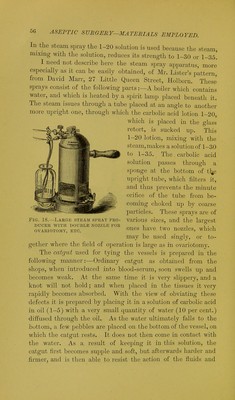
![CHAPTER III. ASEPTIC SURGERY—MATERIALS EMPLOYED. Problems to be solved in order to keep a wound aseptic: Carbolic acid— Carbolic lotions—Pm-e carhoUo acid—SohiUonin methylated sjnrit—carbolic oil—Carbolic acid and r/b/eerine : Spray producers: Catgut—Carboliscd catfliit—Mr. Lister's carboliscd chromic, catgut—Dr. MacEwen's chromic catrjut—■ Catgnt trough and pocliet cai^e: Carbolised silk: Protective: Carbolic gauze—Composition—Method of ■i)re]7arntion—Von Brims' gauze: Mac- intosh : Sponges : Boracic acid—Boracic lotion—Boracic lint—Boracic ointment: Salicylic acid—Salicylic acid cream—Salicylic ointment: Chlo- ride of zinc: Iodoform : Carbolised cotton wool. Aseptic surgery is based on the principle first enunciated by Mr. Lister, and indicated in the preceding pages; viz. the exclusion of active ferments from the discharges of wounds. Theoretically, this is the ideal form of antiseptic surgery, for here, supposing that the attempt is successful, the causes of putrefaction do not enter the wound in a state capable of pro- ducing fermentation, and therefore decomposition of the dis- charges, or of dead portions of tissue, &c., cannot possibly occur. The problem which Lister sought to solve may be shortly stated as follows :— On all objects in the external world septic dust is present— on the skin of the patient, on the hands of the surgeon and his assistants, on all instruments, in water, in the air, &c.; and when a wound is made any introduction of this dust must be carefully avoided. Then after the wound has been made, care must be taken to prevent its entrance during the after-treatment. Some sort of dressing must be provided which shall prevent its passage in an active state, and at each change of this dressing the problem is the same as at the time of infliction of the wound. Such being the question](https://iiif.wellcomecollection.org/image/b20409928_0080.jp2/full/800%2C/0/default.jpg)