Practical physiology of plants / by Francis Darwin and E. Hamilton Acton.
- Francis Darwin
- Date:
- 1894
Licence: Public Domain Mark
Credit: Practical physiology of plants / by Francis Darwin and E. Hamilton Acton. Source: Wellcome Collection.
86/354 page 62
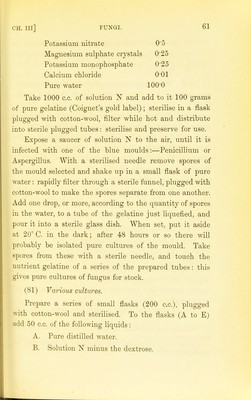
![C. Solution N minus the peptone and nitrates. D. A 10 /o solution of dextrose only. E. Solution N. [N.B. These experiments need the greatest possible care to avoid any trace of impurity in the salts, water etc.] Add to each flask one drop of pure water in which spores have been shaken, and separated by filtering through cotton-wool as described above, taking care that the drop contains only a few spores. If properly done each drop should contain about a dozen spores. Place the flasks in a temperature of 20° to 25° C, and compare the growths, which will be as follows:— A. No perceptible growths B. Fair growth at first which soon, however, comes to an end. C. Hardly perceptible growth which soon stops. D. Fair growth at first, ceasing soon. E. Standard growth, rapid and large. If snfiicient care is taken as to absolute pimty (a difficult bit of manipulation■■'), it is possible to show, by leaving one out at a time, that each of the salts mentioned is necessary. Also to show that, with Penicillium, magnesium sul- 1 The microscope shows that the spores germinate, but the mycelium does not continue its growth. - Owing to the cotton-wool, dust, glass, water &c. rather than the chemicals themselves.](https://iiif.wellcomecollection.org/image/b21500162_0086.jp2/full/800%2C/0/default.jpg)