Licence: Public Domain Mark
Credit: Elements of histology / by E. Klein. Source: Wellcome Collection.
68/378 page 52
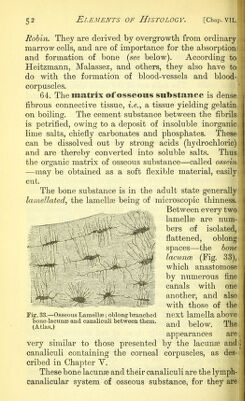
![Rohin. They are derived by overgrowth from ordinary] marrow cells, and are of importance for the absorption and formation of bone {see below). According to Heitzmann, Malassez^ and others, they also have to do with the formation of blood-vessels and blood- corpuscles. 64. The matrix of osseous siil>staiice is dense] fibrous connective tissue, i.e.^ a tissue yielding gelatin on boiling. The cement substance between the fibrilsj is petrified, owing to a deposit of insoluble inorganic lime salts, chiefly carbonates and phosphates. These can be dissolved out by strong acids (hydrochloric) and are thereby converted into soluble salts. Thusj the organic matrix of osseous substance—-called osseinl —may be obtained as a soft flexible material, easily} cut. The bone substance is in the adult state generally ' lamellated, the lamellae being of microscopic thinness.: Between every twO; lamellse are num-; bers of isolated,; flattened, oblong spaces—the hone\ lacunce (Fig. 33), j which anastomose? by numerous fine canals with one, another, aild also with those of the Fig. 33.—Osseous Lamellae; oblong branched next lamella above iA?its!r''^^''^'^''^^''''^ ^eio^- appearances are very similar to those presented by the lacunae and ; canaliculi containing the corneal corpuscles, as des- cribed in Chapter Y. These bone lacunse and their canaliculi are the lyniph- canalicular system of osseous substance, for they are](https://iiif.wellcomecollection.org/image/b2041044x_0074.jp2/full/800%2C/0/default.jpg)
 No text description is available for this image
 No text description is available for this image
 No text description is available for this image