Licence: Public Domain Mark
Credit: Elements of chemistry / by Thomas Thomson, M.D. Source: Wellcome Collection.
Provider: This material has been provided by the National Library of Medicine (U.S.), through the Medical Heritage Library. The original may be consulted at the National Library of Medicine (U.S.)
70/356
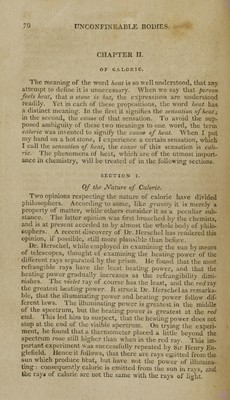
![miles; of course its velocity is not much less than 200,000 miles in a second. From this velocity, joined to the impercept- ble effect produced by the impulse of the particles of light on other bodies, it is obvious that its particles are inconceivably minute. Hence the reason that they produce no perceptible ef- fect upon the most delicate balance. While a ray of light moves in the same medium, or when it passes perpendicularly from one medium to another, it does not change its direction. But when it passes oblicpiely from one medium to another it changes its dii -ction, and is then said to be refracted. When it passes from a rarer to a denser medium, it is refracted towards the perpendicular ; when from a denser to a rarer, it is refracted from the perpendicular. In the same medium, the sines of the angles of incidence and refraction have a constant ratio. When a ray of light strikes obliquely against a plain surface, even though transparent, instead of passing through, it is bent back in a contrary direction. Just as would happen if an elas- tic ball were made to strike obliquely against the ground. The ray is then said to be reflected. The angle of reflection is al- ways equal to the angle of incidence. When a ray of light passes within a certain distance of ano- ther body, it is bent towards it; at a different distance it is bent from it. In the first rase, the ray is said to be infected, in the second to be defected. When a ray of light is made to pass through a triangular glass prism, and received upon a sheet of paper, the un.isje or spectrum, as it is called, instead of being round, is oblong. This spectrum exhibi s seven different colours, in the following order, beginning with the lowest; red, orange, yellow, blue, indigo, violet. In this ease the refraction of the ray is in- creased by ^ie figure of the pi ism, and if it be heterogeneous,, and consist of rays differing in refrangibi] will separate from each other, the most refrangible- going to the top of die spectrum, the least refj angible to the bottom, and the others in their order. This is the case. Light consists of seven differ- ent rays distinguished by seven different colours. The red is the least refrangible, and the violet the most. The refrangibi- lity of the rest is in the order of their names. The lays of light differ in their power of illuminating ob- jects. The ilghust green or deepest yellow gives the most light, and tiie light diminishes as we approach either extremity of the spectrum. The violet has the least illuminating power. Light is capable of entering into bodies and remaining in them, and of afterwards being extricated by various means. Such bodies are saidtd'phosphoresce. Almost all bodies po* sess this property to a certain extent. If they be exposed to the sun, and suddenly earned to the dark, they are luminous](https://iiif.wellcomecollection.org/image/b21159622_0070.jp2/full/800%2C/0/default.jpg)