A pocket botanical dictionary comprising the names, history, and culture of all plants known in Britain; with a full explanation of technical terms / By Joseph Paxton ... assisted by Professor Lindley. A new edition. With supplement containing all the new plants since its appearance.
- Joseph Paxton
- Date:
- 1849
Licence: Public Domain Mark
Credit: A pocket botanical dictionary comprising the names, history, and culture of all plants known in Britain; with a full explanation of technical terms / By Joseph Paxton ... assisted by Professor Lindley. A new edition. With supplement containing all the new plants since its appearance. Source: Wellcome Collection.
34/444
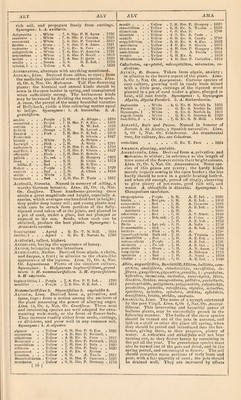
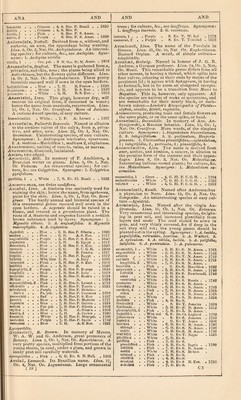
![ANA 1 ana ana on the bitter almond, llich mould is« a proper medium for them. They are most valued for pro- diieinjf their showy pink blossoms early in the season, sooner than almost any other shrubs. Si/no- ni/ine: ). Prunut sinensU. cominiinls . . . Rrd , . 4. H. De. T. Ttarti?.ry Hiiifird . . . Kfd . . 4, H. De. T. n.irhary . lS4U frrttrl i* ■ . . Red . . 4, H. De. T. IJarhary . nincrncflrp.t . Red . . 4, H. De. T. Rart.ary . per'iculdcfl . . Red . . 4, H. De. T. DarhHry . incftnA .... Red . . 4. H. De. S. Canotsus . campi?'trl8 . . Red . . 4, H. De. Podnlia . . IRIR georfflcA . . Red . . 4, H. De. S. Ceoigia. . IHIG c.rienifilt' . . . Reil . . 4. H. De. S. Levant . . 175f» p'liniiil, 1 . . . Red . . 4. H. De. .S. Cliiiia . . ]f)R3 aiblrlcft .... Red . . 4, H. De. SSiberia . . 1820 AMYi.ACEOrs, p0Pse.5?ing the properties of starch. Am^hTs, Linn, From a, intensive,and rnyron,balm, or myrrha, myrrh; in allusion to the strong per¬ fume of the species. Linn. 8, Or. 1, Xat. Or. Amy- ridacete. Ornamental trees, succeedin;' well in an oqtial mixture of loam anti peat, and are propaerated from cuttings in sand under a glass. A, toxifera is poisonous. Synonymes: 1. A, elemifera. 2. A. balsatnifera. acuminf.t;! . . White . S. Ev. T. E. Ind. . . 1023 brasilicnKls . . White . 8, S. Ev. T. JJrazil . . 1823 heptnpliyll.t . . Wliito . S. Ev. T. E. Ind. . . 1R23 LtinAnI . . . White . 7» S. Ev. T. Jami«icA . 1020 mirtttind . . . . S. Kv. T. S. Ainer. . 1810 nflnit .... Wl.ila . S. Ev. T. E. Dal, . . 1822 Ph.mierl, 1 . . White . S. Ev. T. W. Ind. . 1820 sylviUIcil . . . Wiiite . 7* S. Ev. T. Oirliia^e . 1783 TecomftcA . . . Widte . 6. Kv. T. .Mesico . . 1827 toxifera, 2 . .White . S. Ev. T. W. Ind. .1818 AnabasTs, X-inn. Equisitnm, was so named by the Greeks. Litin. 5, Op. 2, Nat. Or. CAenyptiJ/acete. Curious species of tlie simplest ctilture. Synonyyn^: I. Salsota articuliita. aphYllil, 1 . . . Green . . 7. R- Ev. S. A. Minor . 181? liOrldA .... Grocn . . 7. H* A. Dnuia . . 1817 (ipponitiAfiril . . Grn. yel. . 7< H. A. HiiBAia . . 1835 tainiiti»cilullil . Ureen . . 7i R- Ev. S. Spnin . . 1752 Anacampskros, Ehrhart. Compounded from ann- kampio, to induce to return, and erot, love; the name of a plant to which the ancients attributed the quality of restoring the passion love. X.tn«. II, Or. 1, rvai. Or./*cir/u^facetp. A genus of curious succulent plants; for culture, &c. see Aloe. Sy- nouytfu's: 1. Rulingia polypliyl/a. 2. Tatinum ana- ctimpseros, Rulint^ia Anacarnpeeros. 3. R. variana. ftnRustifAliA . .Pink . . 7, A Ev. R. C. R. H. .1820 arachnoidi's . . Pink • . 8, R. Kv. S. C. R. H. . 1780 fllnmentOSii . . Pink . . 8, G. Kv. S. T. 0. H. • 1795 intermedM . . Pnik . . 7. G. Ev. S. C. G. H. . 1824 InnceolflU . . . P nk . . 9, 0. Ev. S. C. G. H. . 17!'6 polyphvlli, 1 . . Pink . . 8, 0. Ev. S- C. G. H. ; 1818 rolundiyoly, 2 .Pink . . 8, 0. Ev. S. C. 0. H. .1733 rObCD* .... Red . . 8, 0. Ev. S. C. G. H. . 1796 rufesesns . . . Pink . . 7, C. Kv. S. C. G. H. . 1818 T&rl&Ds, 3 . . . Pink . . 8, G. Ev. S. C. G. H. . 1813 AnacXmptTs, Rickard. Named from anacatnpio, to turn back ; in allusion to the rertexed state of the pollen masses. Linn. 2U, Or. l,Nat. Or. Orchidacex. An interesting native species, very similar to our orchis; cultivation simple. Synonyme: 1. OrchU 2}yra}nidalis. pyrnmidAlIs . . Red . . 7r H. Tor. BriUvin . . Anacantiious* spineless. AnacardTOm, Ro-rlmrgli. The name refers to the form of the nut; hence the derivation from ana, like, and knrdia, heart. Linn. 2.1, Or. 2, Nat. Or. Anacardiacetc. These ornamental trees thrive in liglit loamy soil, and cuttiutis with their leaves on, taltcn from ilie ripe wood, will strike in sand, in heat, tinder a gla.'is. A. «icc»</rn/tile is thus spcjken of i)y Air. Sander:—“ Tliis elegant tree, bearing panicled corymbs of sweet smelling llowers, suc¬ ceeded by an edible fruit of ilie pomme kind of a yellow or red colour, 'rhls fruit or ap|ile baa a sub-acid Havour, with some degree of astruigeney.'* OccidentAle . - Orn. rc*d. S. Ev. T. IV. Ind. . IRIlp IndlcAui . • • Orn. red. S. Ev. T. E. Ind. . . Anac^clOs, Linn, Derived from a, privative, nnd nnlliox.a flower, nnd kyklos, a circle; in allusion to the rows of ovaries placed round the disk. Livu. 19, Or. 2, Nat. Or. ComiMisiU. Hardy annuals^ requiring only to he sown in the open ground. Sy- nvnywea: 1. Santvlina anibemoidea. 2. Anthemia vnlent'na. nfirPtls .... yellow . B, If. A. Levnnt . , 1570 elavftti'19 . , . White . R, H. A. Barbery , 1810 r»dia»u«, 2. . .Yellow . C, H. A. S. Eiir. , .1596 AnlhemoIdSa 1, creticus, divaricaeua, orienldlU, valtn- tinna. AkauenTa,/1. lirown. Named from privative, and U'/en. a gland ; the nectariferous gland is wanting. Linn, 4, Or. l,Nat. Or. Proieacece. A handsome species, cultivated In peat and loam, and multiplied by cuttings in sand under a glass, pulchellu . . .Yellow . G. Ev. S. N. Holl. .1824 AN.vr.Ai.us, Tom nefnvt. The power of removing de¬ spondency is attributed to this genus, hence the name from un/rgr/ao, to laugh. Linn. 5, Or. I, Nat. Or. Primulncem. Very pretty interesting species, of ea.<y culture. Sow the hardy annuals in the open ground, and the biennials in pots in the green¬ house or a frame, and plant them out when strong enough. They increase from cuttings planted in any common soil under a glass. Orfila destroyed a dog by making him swallow three drachms of the extract of .4. arrc/wi«. Synonymes: A. pka:nicea. 2. A. collina. cAmU .... Flesh . . 8, H. A. Switzerl. . 1819 friiticOsa, 2 . , Vermiln. . 8, G. D. Morov-co . 18o3 hitllcd .... Blue . . 7, H. A. Nepal . . 1824 latifOlIS • • . . Purple . 8, G. R. .'^p.un . . 1759 linifhliii . . . Bmc . . R, G. B. Forttsal . 1796 Marn'fttti. . . Copper . 7, F. Ev. Tr. Ht brid . 1828 MntiOHl. . . .Blue . .7,0 Her. P. luly . . 1648 liln'-'t-fl . .Lie. . .5, G. Her. P. . 1836 't'llmcirelLDA . I’lr. blue. 9, 0. Her. P. >r.ideini . 1334 tene'! . , >■;.,!< . . 7, H. Ue. Cr. Britain . WvbbianA . .Blue . . 7. F. Ev. Tr. I'nrfuRiU . 1828 WelUianA . . . Cop;>er . 0, F. Ev. TuEug. hyb.. 1830 Arv^nala, 1; carulea. AkXo^rTs, Toumefbri. Named in allusion to the curved pod; from ana, backward, and gyros, a circle. Linn. 10, Or. 1, Nat. Or. Z,egi<mi7io4<e. Ornamental trees, growing in peat and loam, or any light rich soil, and multiplied from cuttings or seeds. The seeds of A. fatida, if eaten in any quantity, produce headach. fiutlJA .... Yellow . 4, F- Ev. S. Spain . . 1570 glAucA .... Yel'ow . 4, F. Kv. S. Eur. . 1300 VntifOlIA . . . Yellow . 4, G. Ev. S. Teneriffe . 1815 AnanXssa, Thunberg. From nonar, the Guiana name. Liniu 6, Or. 1, Nat. Or. Bro»rte/iacetr. The plants that yield this very superior fruit, so mPch esteemed for its sweet aromatic flavour, were first cultivatod in this country at Sir Matthew Dicken’s, at Rich¬ mond, where fruit was first produced in I7IS. There are now as many as thirty distinct kinds described in our gardens, but of these only a few merit cultivati«m; these are the common broad- leaved ^ueen, Iliplcy Queen, and Lemon Queen, Rlack Jamaica, Now and Old Providence, Antigua Mont.Kerrat, and two or three others of verv good quality. There are many ways of cultivating these plants; our experience dictates the following Voting ulants should be potted in a compost of open sandy loam, mixed with a small proportion of cither deer, sheep, or horse-droppings ; the pots should bo well drained and plunged into a tan-bed at about 75 degrees of heat; as the plants increase give them additional pot-room, tising the same soil as before. In fine weather admit air the first thing in the nioming—7 o’clock, and clo«e the house early in the afternoon—3 o'clock; when the paihs should be watered and the plants syringed over the top«, which will cau.se the atmosphere to bo very moi.-it; in tills Slate the plants wiU thrive surprisingly. Fruiting plants must not bo grown in an over-moist atmosphere, but should have when such can be given a freer circulation of air, or the fruit will be of an inferior fl.avour. The temperature in winter sliould bo 70 OP 75 degrees, in summer Wor 05 degree.^*, nnd when closed in the afternoon 190 or llo degrees. The best plants are tibiained from .suckers, but new or very rare sorts are often obtained from the crown of the fruit. After the fruit is cut, the stools should be plunged in a .strong bottom-bent, and strong suckers eqiuil to year-old plants may be soon taken off. Synonymes’ 1. Dnnnelia luridti. 2. il. anuiius 1101](https://iiif.wellcomecollection.org/image/b2933486x_0034.jp2/full/800%2C/0/default.jpg)