A pocket botanical dictionary comprising the names, history, and culture of all plants known in Britain; with a full explanation of technical terms / By Joseph Paxton ... assisted by Professor Lindley. A new edition. With supplement containing all the new plants since its appearance.
- Joseph Paxton
- Date:
- 1849
Licence: Public Domain Mark
Credit: A pocket botanical dictionary comprising the names, history, and culture of all plants known in Britain; with a full explanation of technical terms / By Joseph Paxton ... assisted by Professor Lindley. A new edition. With supplement containing all the new plants since its appearance. Source: Wellcome Collection.
64/444
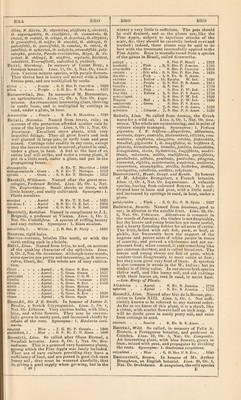
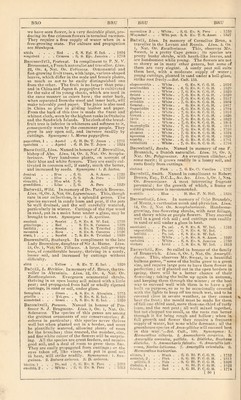
![may be increasetl by seed. At Glasnevin, near Dublin, tlie plant has stixtd the winter in the open air, planted at the bottom of a wall, bftsclloides. . . Wliite. . 7, F. Bl. P. S. Anier. . 18r.6 Houva.'ioTa, Salts. In memory of Dr. Boiivard, superintendent of the royal Paris botanic garden. Linn. 4, Or. 1, Nat. Or. Rnbiacfoe. Tliis is a beau¬ tiful genus, worthy of exten.sive cultivation. D. triphijlUi is a free tlowerer, and thrives in a cool part of tlte greenhouse ; /). versicolor is rather more tender, and thrives best in a wanner situation in summer, but requires to be cool in \vinter. They grow in a mixture of lo:im and peat, and young jilants may be obtained fripin cuttings, which strike in the same kind of soil, in heat; they may also be propagated bj' pieces of the root, j)lHnted in good soil, in heat. Sjinonyme; 1. U. Jacquinii, Hous~ ionia cocciuea. loiigiHC'nl . , . White. • S. Ev. S. Mexico . . 1827 tiipbelbi, 1 . . .ScarUt . 7» G. Kv. S. M'-xico. . 17! 4 puliC'SCens . . Si-arlet . 7, G. Ev. S. .Mexico . . 17!>4 gUbril . . .Scarlet . 7i G. Ev. .S. Mexico . . 1784 vcrsk-rtlOr . . . Red . . 8, G. Ev. S. S. Amer. . 1814 BovIsta, Persoon. Latinised from its German name hojist, Linn. 2), Or. P, Nat. Or. Fungi. Striking productions. Bulliard mentions having seen many of eighteen, twenty, and twenty-three in«‘hes in diameter; and on the authority of others, affirms them to attain the enormous bulk of nearlv nine feet in circumference /{. gigautca is the largest of the genus or order, measuring two feet in diameter. The.fle.«h is at fir.'^t white, afterwards of a greenish-yellow, lastly of a brown grey, the outer peridium cracks, and peels off in large Hakes r)n being handled.—Loudon's Ency. of Plants—gigdntSil, nigt SscStts. BuwiiiA, Haivnrth, In memory’ of .T. Bowie, a col¬ lector (tf plant- for the Kew gardens. Linn. 0*, <‘)r. 1, Nat. Or. Liliacei!-. Curious plants, succeeding in fibrous sandy peat, and multiplied by offsets or suckers. Africftna . . . Red pm. . 10, O. F.v. S. C. O. H. . 1R23 rayriac.tnthA . U»-d grn. . 5, G. Ev. S. C. G. 11. . 18J3 BowlesTa, Romer and Schultes. Named in hontmrof Mr. Bowles, an Irish botanist. Linn. .5, Or. Nat. Or. I'mbellifera’. A minute curious plant, •will grow in any common soil, and is increased by divisions. t^ndri .... Orn. yel. . 7. F. Ev. Cr. M. Video . 1827 BuAnftjCM, L/iin. Named from brabeioti, a sceptre; applying toihe racoiiies of dowers. Linn, if, Or. 1, Nat. Or. Protciiceic. An ornamental tree, suc¬ ceeding bo't in open sandy loam and peat; cutilng.s of the ripened wood root without diiliculiy, in sand, under a glass. stellatmn . . , AVhito . . .1, 0. Ev. S. C. G. H. , 1731 BaACJitATK, h-aving arms or branches usnallv placed opposite to each other .’it riglit angles with the main stem, and cms.sing each other alternately. BaAciivukNA, R. Itnni'u. From brachys, short, and hf/io, cloak ; in alhisinn to the form of the calyx. Linn. IP, Or, 2, Nat. Or. Vom}<osH<e. An ornainefital plant, for the culture of which, see Rucc/mri.v. Synonymes: 1. liaccharis nereij'olia, Tarchonanthus ilcntala. mTeifrtll.l, 1 . . Wliitn . . 0_. G. Ev. S. C. 0. 11. . 1752 BjiACnvpuuTr'M, Iteauiuiis. Taken from brachys, short, and pons, a foot ; in reference to the short stalks of the .spikelets Linn. 3, Or 2, Nat. Or. Gr/j»ni»ie<r. .’\Iere weeds, of tlie sinijilixt i-ulfure. Synonyntes : 1. Trilictnii sspevtiui, Feslnia rigitfti. 2. TriliLiiin Inliaceiitn. ti. linnnus pinnuftis. ■!. U. rupe!>tris. .'». It sylriiiiciis. d. lirachypiuliinn uijrdiis-usp^ifini 1, hniticinlt', hrfvisPtnm, eifsiiitnidin, (listih-lii),‘in. Hill- lerT, I'lliilcfOm 2, longif'olibui, ol-tiisifolifitn, plur- nicottlfs, pinniltbrn !f, rnrnfl.vfl/o, retflsflm. -I, sfrigOsOni, syhuitlcflin 5, tcntdflni <>, Tcnorinnfititf fcnnlcillriin, tetiuiflnrfitn, unilntcrttU, Ila.^ciivsiaMA, R. Itron'n. D'-rived from brachys, short, au<l standard; the. Howers having a v^ry slmrt bl.mdard. Linn, in, Or, 1, Nat. Or. Argo- | Vciy handsouic climbing species, espe- i cially It. InliJ' liii, thriving wel.'iti an equal mixttire | of sandy loam and peat; they arc iiu’reaseil hy i las ers, iir cuttings )tl:imcd in sand, under a glass, I in heat, root freely. They may also be increa.sed bv .seeds, which are sometimes produced. The-e plants are well suited for training up the columns of the conservatory or greenhouse. l.itlfOla'im . . . Crimson , 5, G. Ev. fT N. TJnll. . 1803 uiidiililtLOU . . . Green . . 3, G. Ev. Cl. N. S. W. . I32rt Rracmy<tEi,ma, R. Rrort'n. Named from the word brachys, short, and stehna, a iTown ; in allusion to the short coronal processes of the dowers. Linn. 5, Or. 2, Nat. Or. Ascleuiudace'P. A ctirious plant, grows well in sandy loam, and is increased by cuttings. cri-perum . . . Br. v*L . 0, S. T.i. P. C. G. H. . 1829 tubery-uni . . . Puipiv . t>, S. Tu. 1'. C. G. H. . 1821 Bracteas, small leaves placed near the calyx on the peduncle or pedicel. BR.vni.j'jA, Gaertner. In honour of Richard Bradly, a professor of botany at Cainbridgu. Linn. 21, Or. JO, Nat. Or. EuphorLiaccie. Ciuiuusplants,oflittle interest They succeed in loamy soil, and multiply from cuttings. nu:d.; .... A Ev. S. E. Tnd. , . 1020 sulk'd .... . 7. s. Ev. g. Cliina . . 18l0' Bh.Xctua, small leaves placed near the calyx, on tlie peduncle or pedicel. Bractratk, furnished with braciea. Bract£6i.S, little bractea Brassavola, R. RrntvH. Named after Antonio Musa Bra.ssavola, a noble N'enetian. and one of the most enlightened botanists of his day Linn. 2o, Or. I, Nat. Or. Orchidace.e. The plants of this genus are deserving a piace in every collection of orchidace*, having, when in Hower, a delightfully fragrant od«mr. They require to be propagated, and otlier- wise treated, as Stanhopen. Synonytnes: 1. Epi- dcudrum cucuUatum, Cytnbidium cucultatum. 2. C» nodosum, Epidendrum nodosum. HngUMtAU . . . V-h. prn. . 6, R. EpL Dcmcr.ir* c> . . . . Wilt. grn. 5, Ept. Br-.x 1 . cu.'.dluU, 1 . . . White. . 6. 5<. Kpi. \V. Ind. . ! 1780 ClcgAns . . . I.'lac . . S. Kpi. Ant'gvin. nodes.'., 2 . . gtn. 1, S. Epi. .I.MU.'ica. ! 1830 IVrrinn . . . Wht. i.'rn. 8, S. Ep’. R o Jan. tiibercuJ&t.'l . . . \Vht. \el.. 7> Epi. Br.itil . ! 1827 BrassTa, R. RroMui. Ineommemoration of the late Mr, Brass, a skilful botanical tiaveller and draughts¬ man. Linn. 2o, Or. I, Nat. Or. Orchidacejr. This is a fine genus of plants, all of which are delight¬ fully fragrant when in fiower. The flowers are nio.stly yellowish green, spotted with purple. For culture and propagation, see Sioio- nymcs; 1. Epideudrutn caudatum, .)Ialtij-is candata. cnmUlt., 1 . . . Ysh. . 2, S. Kpi. W. Ind. . 1823 t.'IKtAuA . . . Y»b. s]H>t. 1, t*. Kpi. Suriiinm. . 1533 uifti r(><<'&\.hYd . • (tr«. bni. , S. Kpi. B-inrrAia • m.culAia . . . WIit-bpoL -1, S. Kpi. Jauinica . 180d Br.assTc.X, Linn. From hresic, the Celtic name of the cabbage. Linn. 15, Or. 2, Nat. Or. Crne(ferir. In this gemis «e h.ave the w ell known i-.'ibbagc, with its many varieties, and many other familiar pot* licrhs and roc.ts. It is wonderful to look tipori the c<mum>n cabbage (/{. olcracea) with its varieties, and observe the evceeding great ditVcreuce in appear- aiu-e and qualities, paiti.-ularly when we compare the original typO' lus found on our shores, uiili wavy sea green leaves tending to no hetid, and flowering like wild tmistard or charhu-k, with the caulirttiwer and red cabbage, <S:c. .\s their culture is generally well kiiown, we shall dwell upon it here as briefly as jiossible : the t-abbage and its varieties re<iiure a very stri-iig rich .“oil, or thev ill not eome to .a gooil sire. The turnip also dt'es well only in good rleh s«*il, and indeed the wlu»lc tribe thrive Itest in open loamy soil, enriehed with manure. They all prt>duee an abundanee of seed.s, which must he sown at those periods whiidi expe¬ rience has sho« 11 to V the be*!, for bringing their produec to perfeeticm at certain seasons. ui/mes; X.lt. scmprrvircns. 2. Raphntins r/irirari- thijtilia. 3. fri/cuAnMMi—/ai/edricd 1, C. iiupii llrdsstCii, C. commniits, C. ra* tiibilgd, ('. olclffrd, C. pabuldrUi. cheirauth^f'i'itUl 2, chrir.Uii'hbs, chinPnsis, e.huig.lld. K. racd.'^rOfa.jVM* ticnlOsii, Gravhul, ililfiiiihut, hftmtlls, iardiid, Arri- g(.M, tao<t/<!ai], AJpiD, .Y. escnlfntus, \.](https://iiif.wellcomecollection.org/image/b2933486x_0064.jp2/full/800%2C/0/default.jpg)