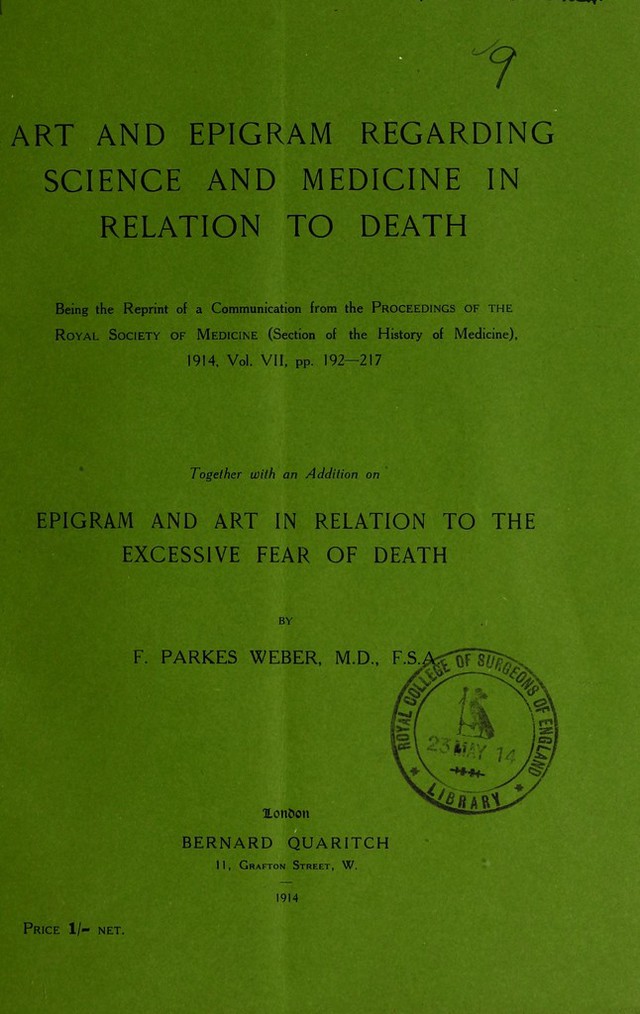
Art and epigram regarding science and medicine in relation to death : being a reprint of a communication from the Proceedings of the Royal Society of Medicine (Section of the History of Medicine), 1914, Vol. VII, pp. 192-217 : together with an addition on epigram and art in relation to the excessive fear of death / by F. Parkes Weber.
- Frederick Parkes Weber
- Date:
- 1914
Licence: In copyright
Credit: Art and epigram regarding science and medicine in relation to death : being a reprint of a communication from the Proceedings of the Royal Society of Medicine (Section of the History of Medicine), 1914, Vol. VII, pp. 192-217 : together with an addition on epigram and art in relation to the excessive fear of death / by F. Parkes Weber. Source: Wellcome Collection.
Provider: This material has been provided by The Royal College of Surgeons of England. The original may be consulted at The Royal College of Surgeons of England.
15/34 page 13
![Nicarchus compares another doctor, Zopyrus, to Hermes (Psycho- pompos), the guide to the infernal regions {ibid., 1‘24) ; hut perhaps the wittiest epigram on the wholesale destruction of the sick is one which has been variously attributed to Lucian, Lucilius, and Agathias {ibid., 401). A doctor sends his son to a tutor, but when the boy had learnt the first three lines of the ‘ Iliad ’ [which tell of the Trojan war sending many souls to Hades], his father said this lesson could be learnt at home, as he himself sent many souls to Hades, and for that had no need of a tutor.” Joseph Zabara, the Jewish author of the “ Book- of Delights” (finished about the year 1200), indulges in many gibes against the medical profession, though he himself was apparently a doctor. Thus, the following saying occurs in one edition : “A doctor and the Angel of Death both kill, but the former charges a fee.” Another little story is typical of its kind : “A philosopher was sick unto death, and his doctor gave him up; yet the patient recovered. The convalescent was walking in the street, when the doctor met him. ‘You come,’ said he, ‘ from the other world.’ ‘ Yes,’ rejoined the patient, ‘ I come from there, and I saw there the awful retribution that falls on doctors; for they kill their patients. Yet, do not feel alarmed. You will not suffer. I told them on my oath that you are no doctor.’ ” ^ To enumerate all the ancient and modern satirical sayings^ of this kind and describe their artistic representatives, in the way of coloured prints, &c., would be too great a task. The satirical writings of Moliere against the medical profession of the seventeenth century have their analogues in modern times in England as well as in other countries. ' See Israel Abrahams, “ The Book of Delights and Other Papers.” The Jewish Publica- tion Society of America, Philadelphia, 1912, p. 12. '‘See especially the extensive collection entitled, “ Le Mai qu’on a dit des Mddecins,” by Dr. G. J. Witkowski, of Paris; on the second series of this work is the apxrropriate device of a physician riding, with Death mounted on the same horse behind him. Several typical German epigrams of the kind are given by E. Hollander, “ Die Karikatur und Satire in der Medizin,” Stuttgart, 1905, pp. 175-177. A clever English one is that by “ A. C.” (Spectator, 1897), for which I am indebted to Sir William Osier :— “ Wise Arruns, asked ‘ How long will Caius live ? ’ Replied, ‘ Three days the fatal sisters give’ ; And Arruns knew the prophet’s art. But lo I Stronger than gods above or gods below, Euschemon comes : his healing art he tries, And in a single day poor Caius dies.” About the end of the eighteenth century in England a medical epigram could apparently hardly become popular unless it referred in one way or another to death, Witness the following](https://iiif.wellcomecollection.org/image/b22463604_0017.jp2/full/800%2C/0/default.jpg)


 No text description is available for this image
 No text description is available for this image
 No text description is available for this image