Atlas of the external diseases of the eye : including a brief treatise on the pathology and treatment / by O. Haab ; Authorized translation from the German, edited by G.E. de Schweinitz.
- Haab O. (Otto), 1850-1931.
- Date:
- 1899
Licence: Public Domain Mark
Credit: Atlas of the external diseases of the eye : including a brief treatise on the pathology and treatment / by O. Haab ; Authorized translation from the German, edited by G.E. de Schweinitz. Source: Wellcome Collection.
Provider: This material has been provided by the Royal College of Physicians of Edinburgh. The original may be consulted at the Royal College of Physicians of Edinburgh.
132/312 (page 112)
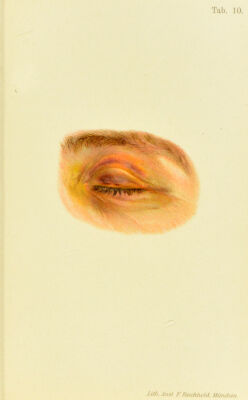
![Plate II. a. Dermoid tumor in a child, aged 1 year. The growth is congenital and is growing very slowly. h. Tlie same in a man, aged 21 years. The characteristic hairs, often seen in a dermoid tumor, are present. The tumor in this case also has grown very little since birth. After removal a small, gray spot appeared on the cornea. applied once a day with a glass rod. Atropin is quite unnecessary unless there is a corneal complication. [Fre- quent cleansing of the conjunctival sacs with saturated boric-acid solution, or with boric acid and saline solution, is advantageous. If reaction is high, iced compresses are useful. Zinc is especially valuable in diplobacillus con- junctivitis.—Ed.] 2. Follicular Conjunctivitis. A chronic form of catarrh, characterized by the forma- tion of numerous granulations on the conjunctiva, more ])articularly in the retrotarsal folds (Plate 14, a). The nodules appear singly or in rows, are of a pinkish-gray color, and vary in size from 1 to 3 mm.; the larger ones arc more or less transj)arent. The disease belongs to childhood and early adult life, and may run its course without marked subjective symp- toms ; or the child may be troubled with blinking (nicti- tatio) and inability to continue at close work. Asa rule, there is little or no secretion. Diag-nosis.—Follicular conjunctivitis is often con- founded with trachoma; but the distinction may be made by observing that the granulations are most numerous in the lower retrotar.sal fold, while in trachoma they are found chiefly in the uj)per curve of the fornix. Prognosis.—The disorder may run a slow and tedious course ; or it may disappear without leaving a trace. Treatment.—Lead, either as an ointment or in .solution, as a collyrium (Plumb, acet. 0.1-0.2 to 10.0, aqiue des- till. or ling, amylo-glycerini). [Excellent collyria also](https://iiif.wellcomecollection.org/image/b21691587_0132.jp2/full/800%2C/0/default.jpg)