Atlas of the external diseases of the eye : including a brief treatise on the pathology and treatment / by O. Haab ; Authorized translation from the German, edited by G.E. de Schweinitz.
- Haab O. (Otto), 1850-1931.
- Date:
- 1899
Licence: Public Domain Mark
Credit: Atlas of the external diseases of the eye : including a brief treatise on the pathology and treatment / by O. Haab ; Authorized translation from the German, edited by G.E. de Schweinitz. Source: Wellcome Collection.
Provider: This material has been provided by the Royal College of Physicians of Edinburgh. The original may be consulted at the Royal College of Physicians of Edinburgh.
136/312 (page 114)
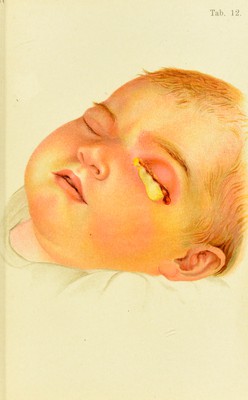
![Plate 12. Gonorrheal Conjunctivitis in the New-horn. .sistiiig of blood and serum, 'which has been likened to bouillon. Jk)th eyes are usually affected, one a little later than its fellow. The conjunctiva in the first stage is red and swollen, but smooth. Edema is usually ab.sent iu infants. After a few days the secretions become more purulent, the swelling of the lids diminishes, and the skin oyer the lids appears wrinkled; the conjunctiva is .soft and ])uck- ered into folds, the color deepens to a dark red, the surface is rough and velvety, and longitudinal folds a])pear in the region of the fornix. At this time thick, yellow pus is .secreted in large quantities and oo/.es out of the palpebral fi.ssure (Plate 12) or collects in the folds of the conjunc- tiyal cnl-de-sac. Du ring this second, or true gonorrheal stage, which may last for wcek.s, the cornea is in the greatest danger. The se(!retion, if not removed from the conjunctival sac, attacks the cornea ; at first a small, gray patch aj)pears at, or a little below, the center of the membrane ; it increases rapidly in size and is soon converted into a mppuratinc/ ulcer, which spreads over the entire surface and may lead to perforation. If perforation takes j)lace, the suppurative process invades the deeper ti.ssues and gives rise to viru- lent inflammation in the anterior portion of the eye, or even to panophthalmitis-. Sloughing of the entire cornea may easily lead to prolapse of the lens; in smaller perforations there is more or le.ss adhesion of the iris to tlie opening, and n staphyloma may restdt. If the perforation is very small and centrally situated, the cornea may escape with a central macula; but in this case the lens may suffer from the prolonged contact with the ulcerated portion of the cornea, the endothelial cells of the anterior eap.sule pro- liferate, and an anterior capsular or pyramidal cataract results (Plate 34, a). The residting corneal ojxacity may be much le.ss than the lenticular; but not infrequently](https://iiif.wellcomecollection.org/image/b21691587_0136.jp2/full/800%2C/0/default.jpg)